🎧 Here on The ChinaHealthPulse Podcast, I chat in depth with the real experts who have dedicated years to working in and with China’s health - across policy, industry, academia and well beyond. Our candid conversations aim to provide you with real insight into how care is delivered, how decisions are made, and why it all matters, far beyond China’s borders.
Watch or listen here on Substack or YouTube, and/or subscribe on Spotify & Apple Podcasts. These newsletter posts provide all links, plus a full text transcript of each episode.
China’s healthcare sector seems to produce a new headline almost every day now: another (billion dollar) biotech deal, a new AI technology or robot, or a fresh supply chain or geopolitical dispute.
But the China story is becoming ever more complicated. It remains one of the world’s largest markets for medicines and medical devices, it is at the same time becoming one of the most important sources of the assets, technologies and manufacturing capabilities that global life-sciences companies increasingly depend on. This means that China and its health role is becoming harder to navigate at the same moment that it is becoming harder to ignore.
So what should biopharma and medtech companies - and the investors behind them - actually understand about China now?
Franck Le Deu is particularly well placed to answer this question. He is a senior strategy leader who has spent more than two decades at McKinsey and more than two decades in China, where he helped build McKinsey’s life sciences work and advised leaders across biopharma, med-tech and investment.
He remains Senior Partner Emeritus at McKinsey and is now Venture Partner at Aulis Capital and Managing Partner at KerZheng Ventures. That means he now sees these decisions from another angle too: working closely with founders, investors and companies building across China, Asia and global markets.
These issues also sit at the heart of my new book, China Cure: The Rise of a Biotech, AI Medicine and Global Health Superpower, available now for pre-order on Amazon, online and in bookstores. Look out for my next substack post for more details!
Watch/listen/read this episode on Substack, on YouTube, or subscribe to the audio podcast on Spotify and Apple.
Read our Conversation:
(Audio transcript adjusted for clarity and flow)
1. How to Enter and Build in China as a Global MNC
Ruby: Let’s dive right in. You have spent over two decades advising leaders and global corporations in health and life sciences in China. So you’ve seen companies achieve quite different results as the decades have gone by. What do you think separates those that build a significant and successful China business from those that are still facing particular challenges? And what capabilities have you seen matter more than others?
Franck Le Deu: Yes, I was fortunate to land in Shanghai in 2005. So over 20 years ago, I thought I was going to stay for a year and then go back to my home office of New Jersey with McKinsey. But I saw the opportunity and decided to stay. In 2005, there was not much to talk about, quite frankly. China was just a commercial market for branded generics effectively – the drugs that companies were selling were off-patent drugs that were mature brands, and the size of the business was a couple of hundred million dollars maximum for the largest players. There was no R&D to speak of. Manufacturing was very basic, just tablets and filling stuff. But you could see the making of a good story, and I’ve been fortunate to follow that story for two decades and be part of it.
To your questions, I think what makes the difference between success and maybe not so much success. You need to divide it into two parts. One is commercial success in China, the other one is access to innovation from China for the global operations.
Commercial success in China is a combination of a portfolio that is actually a good fit for the needs of the Chinese population; long-term commitment starting from the CEO and being embraced by the organisation; resilience because there has been a lot of ups and downs actually in this great China story; and adaptability and willingness to empower the local China team to actually think through what should be adapted in terms of access strategy, go-to-market model, etc.
There’s also a matter of scale. The not-so-dirty secret of the China market is that making profits in China, just like for any industry, is actually difficult. Multinational pharmaceutical and med-tech companies that operate in China have challenges in reaching the type of profitability that they would capture in other markets - the US obviously, which is the centre of profitability for the global industry, but even Japan and EU markets.
And that is driven by the cost of doing business in China, which is actually quite significant given the fragmentation of the landscape and the size of the team you need in order to cover the market, but also the low pricing that people get for their innovative drugs or mature drugs. And therefore, companies who do not have a large portfolio struggle to make acceptable returns on their investments. And that’s what we’ve seen over the years.
A few companies emerged as having scaled business in China with deep commitment to commercial success, simultaneous launches for their new drugs, heavy investment in launches. These are companies like AstraZeneca, Roche, Novartis. And then you have companies who have struggled and have not captured that opportunity. I won’t name names here, but there’s a large list, and they could be from Europe, could be from Japan, they could be from the US - it’s not region specific. So commercially, going forward, you need scale of portfolio, you need deep commitment, you need adaptability. And if you don’t have those elements, don’t think China is for you.
Now there’s a second part, which is access to innovation. And here I think winners and losers, we don’t know yet. What’s clear is that some companies have started earlier than others to source innovation from China. And to some extent, they were the same ones that had a strong commercial presence, maybe because that success on the commercial side helped global headquarters to believe in the innovation story earlier. And therefore, those companies took steps investing in venture capital funds, doing partnerships and licensing molecules, and later on starting to create new-cos, things like that. Maybe building on the ground, partnership and licensing teams on a significant scale, actually.
So those companies have a head start, but you could see in the last two to three years that many other companies with limited presence in China on the commercial side are trying to catch up and are actually doing some very interesting deals to license best-in-class innovation from China and even potentially first-in-class. I say “potentially”, because only time will tell if some of those molecules licensed from Chinese companies at early-stage, Phase I, sometimes even preclinical - if those drugs are differentiated and make it to the market.
So it’s a story that will play out in the next 5 to 10 years. But I would therefore again differentiate between the commercial opportunity where you clearly have some winners at this point (and it’s difficult, I think, to close the gap if you have not already committed to China), versus the innovation sourcing, where it’s still very much in play in terms of who is going to emerge as a big winner - and there will be probably multiple big winners from that trend.
Related:


2. The Right Timing
Ruby: That’s a great introduction to set us off. I would like to ask about China as a market opportunity versus that global source of innovation next. But first, you mentioned about if they’re not already in China now, it’s becoming increasingly hard to close the gap. in my own consulting, I’m hearing this question a lot. There’s a lot of “fear of missing out”. Companies that haven’t previously thought of China as an opportunity are now rushing to rapidly upscale themselves and their own teams and wanting to make sure they don’t get left behind. Is it becoming too late to get into China or is there still some opportunity to catch up?
Franck: I think it all depends on the quality of your pipeline and assets you can bring to China. If they are highly differentiated, address an unmet need that is real in China, and you are willing to commit to a Chinese opportunity and are willing to potentially partner with a local Chinese company, I think it’s still possible to catch up. And if you have a pipeline, that goes beyond just a one hit wonder drug, right? You need to have a pipeline of assets that is going to give you a long lasting presence in China, not just for a few years. Then, yes, it’s still possible to build a sizeable and successful business in China.
If your pipeline is not very differentiated, or you only have a couple of drugs and you want to control everything and want to see results very quickly, most likely stay home, you will not succeed. It’s as simple as that. But this point about pipeline is very important because some companies who have today an established presence in China have been successful for decades for some of them. I think they always have to renew their pipeline on a global basis, but also in China. Because, as you know well, pricing in China is challenging. Local competition is on your heels very quickly. Not just with the threat of generics, but more broadly with the threat of best-in-class.
Assets that can be launched by local companies and will go after your main business. We can see what happened with PD-1s, for example, right? Where BMS and MSD (Merck) faced a lot of competition from many, many local companies. Over time, that competition has skewed, at least in volume, towards the local companies. We have to see now what happened with GLP-1s and what Lilly and NovoNordisk are doing in China and how like competitors like Innovent and others are also going into that space and how that dynamic game will play over time.
Again, the challenge for multinationals is simple. I put together a slide a couple of years back that was basically showing profitability of a pharma company in China versus scale. You could see that unless you reach a certain scale, you will never get to the type of profitability that headquarters will accept. Now, the headquarters will accept lower profitability in China, which hopefully will get better over time - which we can debate. But they will not accept very low profitability in China. There’s an opportunity cost of putting a dollar on the ground in China versus putting it back in the US - which is what people tend to do, or even sometimes putting it in Europe or Japan. The opportunity cost is clear, and therefore, companies have to think about China commercially as an opportunity that needs to be assessed against the portfolio of opportunities they have.
Now, obviously, there’s a layer of strategic thinking that you need to add, because China offers diversification on revenue pools, which is very important. It’s important today, it could be critical in five or 10 years. So there’s a long-term view that people or companies need to have about the China opportunity. The commercial market could improve - we know that commercial health insurance, for example, could come in China in a bigger way, which could help. There’s a stronger recognition of real innovation by the government. So maybe pricing pressure will ease off a bit over time - it’s possible. And the economic development of China continues, so people have more out of pocket money to pay for innovative drugs. All of those things are great. So long term, the market will continue to grow. Pricing pressure could be a bit lower, ease off a bit. And therefore, it could become a great opportunity in 5, 10 years. So people have to also balance the short-term P&L (profit and loss) implication with the strategic upside or strategic optionality that being in China offers. It’s the global strategy and China is part of global and therefore has to be accounting for in decision-making.
Related:

3. Aligning Global and Local Strategies in China
Ruby: And thinking about China versus global and HQ - wherever that might be around the world for a multinational company - versus the China footprint and the China team, the stereotype of any global company is the siloing between local and global and maybe strategies might not align or lack of understanding of cultural fit, policy landscape, the health system and providers, patients and how they access and affordability. All of those challenges, can you share a bit more, through all of your work at McKinsey and now beyond, where have you seen successful alignment versus disagreement, overestimations, underestimations?
Franck: Yeah, there are a lot of positive stories I could share, a lot of negative stories, too. I cannot name names obviously, but one of the challenges multinationals typically have is rotation of CEOs. New CEOs may have a different view on China. Sometimes senior executives sitting in headquarters may have had an experience in China that dates back five years ago, ten years ago, that has left a deep impression on them and it’s very difficult for them to then change their impression, positive or negative.
And then the China General Managers themselves rotate a lot. Some of my clients that I served for 20 years in China, I saw maybe six or seven generation of GMs, country presidents. And that’s a fast rotation, in a market that also changes very, very fast. It means that staying on top of the changes, even understanding what’s going on, takes a year at least for a new GM. They start to have a handle in a year, and then by the third year it is already time to think about moving back to a different market or back to headquarters. So that doesn’t help.
I think the companies that have been maybe more successful establishing that headquarters to local China operations relationship are the ones providing more stability actually in the China leadership. Sometimes the GM staying in their position for five years.
Also, having Chinese leaders versus foreigners, On this, both cases have successful, but who actually sit on the executive leadership team, and therefore is not buried in the organisation under a head of Asia or a head of international, who is under more layers. I think obviously there are nuances to that, but in general, if China is elevated in the reporting structure and has a seat at the table for all senior executive discussions, that helps a lot.
One thing to consider is not to think of China as just a China business. China is part of a global business and should be associated with all global decisions. Even at McKinsey, I was telling my colleagues in the China practice, we are not strategising for China, always reminding them we are strategising globally, it just happens that we are based in Shanghai, which is the epicentre of the most important market in the world next to the US. And so that’s a framing, a mindset to have that you are actually not China, you are global sitting in China. It also obviously leads to the type of talent and calibre that is appointed into a China position. They need to be top notch. They need to be high-calibre, rather fast-moving individuals who have a destiny maybe to one day take a much bigger position in the company.
And this actually happened for a period of time in China. I remember in the late 2000 to mid-2010s, a lot of senior leaders came to China to be China president of a multinational operations, then went back to headquarters. David Ricks, for example, who is now the CEO of Eli Lilly, was in China back in 2008, 2009; Luke Miels, who is now the CEO of GSK, was the head of Roche Asia Pacific and based in Shanghai for a few years.
It’s also very important that the board and the executive team of a company get real first-hand exposure to China, not just reading papers, or listening to podcasts like ours even! but getting on the ground in China. And then in China itself, it’s not just in Beijing and Shanghai. There are multiple hotspots of innovation that needs to be understood, like Suzhou, Guangzhou, others. To make sure that people also do not form their opinion based on what they see covered in the press, in their local newspapers.
That’s increasingly important as the US-China tensions in biopharma continue to rise. There’s a lot of political anger now coming into this debate about what is the China opportunity in biopharma; is China a threat to US dominance in biotech. If you sit in the US, and you are a senior executive from a big multinational, and your main source of information is that angle, then you are missing a real understanding what’s happening in China, and your judgment becomes biased in a way that is not productive.
Being on the ground in China, seeing the scale of hospitals, meeting with the CROs, meeting with CEOs of first-in-class biotech that are coming up, talking to people on the ground who’ve been there for a while, seeing the infrastructure overall. All of that is a necessary condition to even start to have a dialogue and structured thinking around the China opportunity and thinking about the risk and threats. know, caliber of talent in China, stability, engagement of a global team with China, those are actually pretty simple things. But the number of companies who do that at the level that’s required to really get to a great balance on China is actually surprisingly small still today.
4. Talent Dynamics: The Chinese Workforce in Global Firms
Ruby: It’s really interesting to hear what you were saying about global CEOs - a lot of them having China expertise and that being one of the reasons why they were selected - perhaps because understanding China as their second or third largest market is essential. What about the Chinese talent on the ground? A lot of the Chinese sales teams, government affairs, clinical - they often move between multinationals inside China. They’ll spend five years here, five years there. So they know the landscape, but are they globally oriented enough themselves, or sufficiently localised to bring their expertise (to deliver for a foreign MNC)?
Franck: It’s a mixed bag, and I don’t think companies have yet found the right recipe to make it work. The truth is that the pool of talent in China is more shallow than we would like still. Why? Well, because companies have had explosive growth. Some of those companies who had 200 million USD in revenues back in 2005 now have 5 billion, 6 billion USD revenues today. So in 20 years, they went x25, x30 on their scale.
Not only that, but the ecosystem around them has become much more sophisticated. They now need to engage their global R &D colleagues. They need to engage global manufacturing - which was an afterthought back in 2005, even up to 2015 - so the skills of those managers have had to evolve as well, just beyond managing a bigger P&L.
And that pace of evolution of the market has created many opportunities for the most talented people to jump around a little bit, which is something we observe in pharma industry already in the West, but has become even more visible in China. Yes, people could spend two years here and go there for another year and move again, partly sometimes chasing promotions, because there’s such a competition for talent that bigger title, bigger compensation opportunities, all of that comes in.
Then you now have competition coming from a local Chinese company who ten years ago started to hire talent from multinationals. And this has been a mixed bag because for a Chinese person who has been “trained and raised” into a multinational environment to move to a local company with very different culture - it’s not necessarily a guarantee of success.
Actually, we had many rejections, like organ transplants not working out. Those people tend to migrate back to multinationals where the culture and the values are maybe more in tune with what they know and want. There is that, then there is the fact that companies have tried often to create leadership development programmes where they would pick some of the most talented Chinese colleagues, send them to the US or Europe for rotation programmes with the hope of bringing them back to China. In some cases, those people never came back.
If you look, we have very few examples of Chinese leaders who have emerged from China and have actually taken on global roles. I mean, there’s a few, and they are very successful. I’m thinking people like Hong Chow, for example, who was at Roche, then went to Merck, and now is at NovoNordisk in a very senior position. You’ve got Ingrid Zhang, my former colleague at McKinsey who had a great career at AstraZeneca and Novartis - she was leading Novartis China and she’s now at a senior position in Basel for Novartis. There are a few more, but it’s a handful and we need to see more. So there’s still a gap in talent in China. People obviously are very smart, they work harder than in the West, they are ambitious and optimistic about the outlook. But they have not necessarily had the type of mentoring and time to really mature fully as leaders. And I think that’s just going to take more time. You also have compounding factors, like obviously how the new generations think about working for multinationals and impact of AI and all those things that make also career path less certain. You put your finger on a very important topic, but is also going to determine who really can continue to be successful versus the one who will be struggling.
Related:


5. Governance and Policy in China
Ruby: So talent strategies are pain points - let’s move on, to some other pain points. If we are thinking about China’s distinctive governance model and what that means for how you operate there successfully. This can often mean that government affairs and policy teams have very big roles in China, when compared to other markets. This is a topic that leaders back home in HQ might worry about - how to optimise the policy side of things. Can you share a bit more from your work?
Franck: I think the challenge people have is that, at one level, China is extremely predictable. You could even say more predictable than, for example my home country of France right now, where we don’t know who’s going to be president next year - it could be anything from extreme right wing to extreme left wing with anything in between, and what that would do to policies and current priorities when investments go all about, who knows, right?
In China, at least you have a predictability of a five-year plan. The other fact is that healthcare was prioritised since back in 2006 or 2007. In the five-year plans, biotech and biopharma have been upgraded every time to a higher level of strategic priority. That gives a very strong confidence to participants in the ecosystem that the government is headed towards a certain direction in the next 10, 15 years.
But at the same time, there’s a lot of unpredictable elements about how we get there, right? Because policy implementation is left to local provinces, local cities. There’s a lot of fragmentation. People who sit in the West may think that China is just a top-down country where Xi Jinping decides where everybody was going to do. It’s not that simple. There are actually a lot of nuances. So while you have direction, how we get there could take some unpredictable turn and twists. And that is often a source of frustration for headquarters because their regulatory or government affairs teams who we have told “hey, this is a priority”, but then some short-term decision may feel like it’s not supporting that priority, and it comes as a bad surprise - and headquarters hate bad surprises! They want predictability as much as possible. So that has always been a source of tension.
I think a big part of the education of headquarters around that is to get them to understand that yes, we know that it’s a fact by 2030, the China innovation market will be bigger. There will be more support for innovation. There will be more innovative drugs coming from China that can go to the rest of the world. Commercial health insurance will have made some progress. All of that is true. But how much progress will that be exactly? Who knows, right? It will depend on how policies are implemented. A couple of unpredictable turns can happen.
Just to give you an example, which is not pharma related, but is an example of how China can make decisions that sometimes surprise people. Recently, Meta, the US company formerly known as Facebook and led by Mark Zuckerberg, made an acquisition of a company in tech named Manus. Manus, initially a Chinese company, was using GenAI in the field that was interesting for Meta, so Meta acquired the company. The company was actually based in Singapore. The acquisition went ahead, the integration started. And then a few months later, Chinese government stepped in and said, you know what, this Manus company is actually Chinese. The founders are Chinese, they may have moved to Singapore, but they are really Chinese. We don’t want a US company to get its hand on GenAI related capabilities that we think are strategic for China. Therefore, we ask that that deal be stopped and actually unwinding. And I think the founders of Manus were (at least at some point) not able to leave China anymore. And this is not in biotech, but this could happen as well in biotech at some point, if the innovation coming out of China is seen by the government as world class and strategic, who knows, right?
So this delta between long-term view and what is pretty clear, versus how we get there is what is more choppy. That creates some tension. The other tension, frankly, is the difference in clock speed or metabolic rate or whatever imaginary metaphor you want to use. That is very different between headquarters and China. And as a French person, I can say it! People in the East work harder than people in the West, whether it’s the US or Europe. They have also a very different way of working in terms of collaboration. And therefore things move faster in China.
That also creates frustration more on the China side this time, where they often feel like headquarters are just too slow to react to what’s happening and doesn’t really give them the autonomy necessary to match the metabolic rate of the market itself. So you have tensions on both sides, right? Obviously, and companies have been working on smoothing that out for many, many years, but it’s still a tension point.
Related:


6. The Future of China’s Healthcare Market
Ruby: So thinking about the policy landscape in China and you mentioned previously you’re quite optimistic about where things are heading. There’s still opportunity, commercial opportunity.
We’re seeing really interesting changes. China’s public health model is still the main, but there are increasingly private healthcare system opportunities, private hospitals, a commercial list. Can you share a bit more about where you think things are going that make the opportunity remain strong for the China market for global companies?
Franck: The China market, just to caveat - and people often get a bit misled by some numbers - I’ve seen IQVIA quote numbers about the size of the China market as $120, $140 billion. That’s misleading. The actual size of the relevant market for innovation is smaller than that. Nobody has the exact number because it’s not disclosed that way, but maybe let’s say $30 to $50 billion of innovative drugs market, excluding generics, excluding Traditional Chinese Medicine, excluding some drugs that have been approved and should not be approved - there’s still some of that legacy in the system. So 30 to 50 billion USD in innovative drugs. That’s big, but it’s still a fraction of the US market, obviously. And if you calculate it on a per patient basis, it’s definitely a small fraction of the US. It’s also probably on par with Germany, maybe a bit ahead of France and the UK at this point, but still beyond Japan, probably in total size. But it’s growing at, again, nobody has the exact number, but we think 10, 15% a year. So it’s true that if you fast forward to 2030 and for sure 2035, China will be the second largest innovative market for innovative medicines and vaccines in the world, beyond the US only and probably quite a bit ahead of Japan and the EU5 (France, Germany, Italy, Spain, and the United Kingdom) by then. That’s a fact.
Another fact is that pricing in China is much lower than in the US and in Europe. This has been also a source of tension for MNC headquarters, because launching in China implies accepting at some level a pricing that you will not accept in some other markets. There is willingness to do that because of the volume you can get; because of the strategic aspect of being in China. But it’s obviously a source of tension, in particular when the US is starting to think and actually implementing most favoured nation policies. China is not in that basket so far, but MNC headquarters are asking “if we accept to price our drug at a tenth of what it is in the US, in China, is that going to come back to haunt us at some point in the US market? How do we justify such a difference?” So that’s a challenge.
But I think China’s lower pricing from a commercial point of view will improve with time, because the infrastructure, the hospitals, the implementation of digital health that is happening at speed, AI implementation in the Chinese system, which faster than the rest of the world. The population is getting older, but it is still getting richer, even though the pace of development of the economy is slower than it was 10 years ago, it’s still growing at 4-5% a year. Commercial health insurance has become a big priority for the government. All of that again is going in the right direction. So if you have a broad pipeline of innovative drugs, you should certainly think about finding a way to participate in the China market. That’s my position. And whether you do it yourself or through a partner or through a Joint Venture even, all options can be considered.
And when we think as well about the dynamics in the rest of the world. the US pricing is coming under pressure already. people should not assume that the US’s umbrella of super high pricing will be there forever. I don’t think collapse, but it could erode over time. European pricing, is under pressure as well. One pressure is coming from the US and CEOs of some leading pharma companies, who are basically asking European regulators in a more or less nice way to increase pricing, or face irrelevance or the consequences of innovative drugs not launching in Europe, which is starting to happen. We know the consequence of the Most-Favored-Nation (MFN) policies and the tariffs and all of that. But at the same time, the pressure on Europe is actually more towards lowering price of innovation. I mean, we start to see some policies in Germany around that. France obviously has a huge budgetary problem, hard to see how a lot more money could go into innovative drugs when the country has to pay for pension funds and has to rebuild the military and has to do many, many things. So it is difficult to see the price of innovative drugs in Europe rising meaningfully.
In that context, the China pricing could improve, and maybe the gap with Europe will get smaller over time. And then the volumes in China will be such that this will become a very interesting opportunity. You could also have ways to lower your cost of operating in China by use of digital and other channels that are being built in China for more efficient distribution and things like that.
So yes, I’m optimistic for the China commercial opportunity in the long term. I think that China is a diversification opportunity. For some companies it is already in the here and now, but for most companies it’s still more of a mid to long term bet on how policies are going to change and how relative pricing in different markets will play out.
7. Innovation Export: China’s Growing Influence in Global Biotech
Ruby: Yes, let’s move on to the innovation part of the conversation, as you just said. We see that in headlines, the proportion of out-licensing from China to the rest of the world. It’s been exponential over the past two, three, five years. You’ve been working in this space and now increasingly on the investor side, looking at more early-stage companies too. How are you finding all of this? And, let’s touch on the pain points in this side of the conversation.
Franck: First, it’s been an incredible story because I think it all started only in 2017, really, at full speed, right? With the NMPA reform and China joining ICH and all those things. So it’s nine years, including three years of COVID time. So it’s been incredibly, incredibly fast. It shouldn’t be a complete surprise to people who follow China and have seen the impact of China across a range of advanced industries. Shouldn’t be a surprise either because China declared it back in 2015 in the five-year plan that it was going to be a priority. And when China says something is a priority, typically things happen.
China has an incredible pool of talent. Many, many returning sea turtles, from the US in particular, coming back to China, alongside infrastructure investment by governments, opening up of capital market, big jump in VC funding at the time, the opening of Hong Kong as a stock exchange.
I mean, the whole story was really fascinating to follow. And at McKinsey, was fortunate to document that story a little bit year after year through a report we prepared every year for the BioCentury China Summit that is still taking place in Shanghai every November organised by BioCentury, a publication and information company from the US, and BayHelix, which is a coalition of industry leaders in China healthcare. McKinsey was the insights partner. I reread those reports just before I left McKinsey. And it was very interesting to see the movie play out and how the building blocks were added one by one until we had this inflection point, this “ha ha” moment when people realised that China had arrived on the global stage.
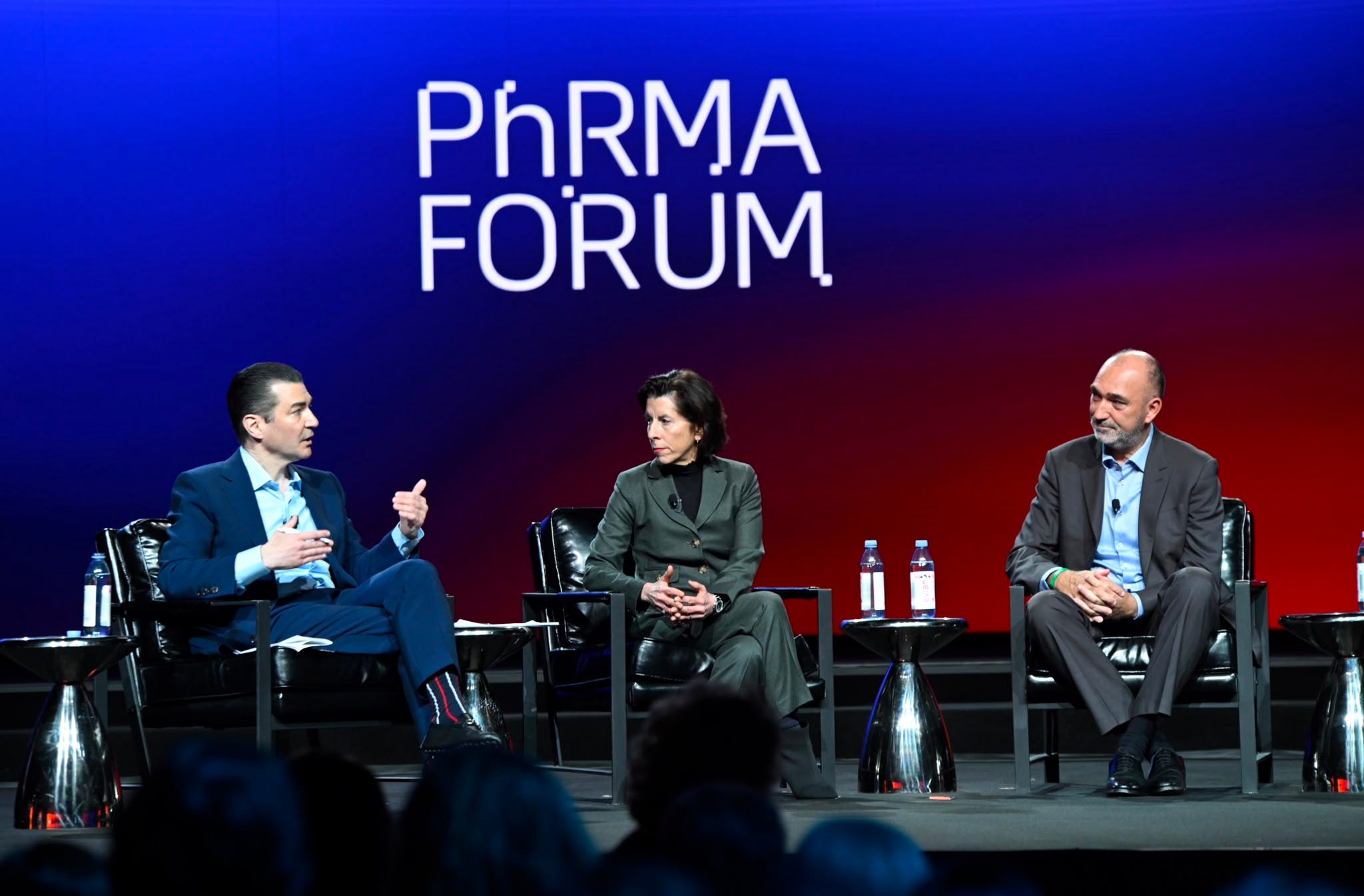
I think actually one of our reports five years ago was named “stepping on the global stage”. And then you had what happened at the J.P. Morgan Healthcare Conference in San Francisco three years ago, I think, when people really started to realise that China was becoming the most important debate topic with a number of deals and new-cos and all that starting to take off. And then lately, I guess in the last year or so, it’s been much more about in particular coming from the US side, “how is China eating our lunch in biotech after eating our lunch in so many other industries” and “how it’s time to stop them”. I myself was invited back in March at the PhRMA Forum in Washington DC, to be on stage with Scott Gottlieb, former commissioner of the US FDA, and Gina Raimondo, former Secretary of Commerce for Joe Biden (video link to panel here).
The discussion was really, okay, how do we stop China from rising? And I was trying to bring a European, more balanced perspective, to the topic, saying that the rise of China actually should be welcomed by patients around the world. That yes, it is creating a threat industrially to the US and Europe, but that it can also be an opportunity for competition and collaboration in the right spots. And it’s a complex picture because we know that Europe has been naive about many industries.
We have seen it in rare earths, which was largely European based. Europe had a strong rare earth manufacturing capability 30 years ago, 20 years ago, and decided to export all of it to China, thinking it’s too dirty to do it in here. Now we see that’s a shock point for many industries. We’ve also seen it in electric vehicles, right? Where obviously Europe now is highly dependent on China as a commercial market. now we are seeing cars from China come to Europe at very attractive price and quite frankly, better cars than what the Europeans can make now. So there’s this fear. But I think the fear is overstated because the biotech industry is a much more global one than even the car industry.
Let’s remember that, if somebody, whether he is British or French or Chinese or American, can discover a drug to treat lung cancer tomorrow, we should all applaud and make sure that that drug can be available for all the patients around the world. We are going to see a world where innovation is going to happen in many hotspots in the US, on the East and West Coasts, and some other places like San Diego and others. In Europe, where we actually have still a strong science base and quite a few hotspots of innovation still in Europe. But also in Asia - and not just in China, by the way, but also in Korea and Japan, and India maybe will play a role in five, ten years as well.
So innovation will come from everywhere. The question is, OK, how do you make that innovation accessible for patients around the world? There are some real concerns in the US right now that, if we move all early-stage innovation to China, what does that do to the ability to run clinical trials in the US? What does that do to our participation in Phase III clinical trials? What happens if any US biotech company that comes up with a great new idea and publishes about it sees 10 copycats from China jumping on it right away, with funding abilities that we don’t have in the West and maybe some shortcuts on regulatory and so on.
We need to step back and then think, okay, there will be three large ecosystems in the world. In this industry in the last 20 years, the big winner actually has not been China, the big winner has been the US all along. The US has become the epicentre of the industry. I call it the sun and then all the other planets and ecosystems turn around it. As a European, I’m saying that it’s not a sustainable position for Europeans to be in, to become increasingly dependent on the US system for revenues, for profit, for investment in European biotech, for IPOs, all the IPOs take place in the US.
Most of the major VCs are US. The innovation is often created or found, developed at an early stage in Europe and then ends up actually owned by US companies or European companies who have to really move to the US to survive. And then the commercial opportunity is largely in the US. So that’s an ecosystem that has been working for some time now, but is actually detrimental to European interests. And we’ve seen that as investment in R &D and manufacturing have started to decline in Europe relative to the US.
And also, quite frankly, decision making in companies has become increasingly focused on the best interest of the US first before Europe. And now we start to see it with most favoured nation policies, where obviously some American companies are starting to say, hey, I will not launch in Europe because the price is too low. But you even see some European companies who starting to say that. So I don’t know how Europe could be happy of being in that situation.
There was a report that came from the European Commission that has been cascaded down into some review of competitiveness in strategic industry for Europe. So there’s an initiative around competitiveness of biotech industry in Europe to try to regain some ground. And that report is interesting, but I found it to be very inward looking: that to stay strong in Europe, we should basically wall off Europe and make sure we keep our industry and don’t become too dependent on others.
I think it’s a mistake. You can do some of that, but the key is to think about how can Europe engage with China or what I call “China Plus”, China, Korea, Singapore, Australia, maybe Japan, to actually create companies from Europe who can develop innovation faster, cheaper, bring them back to Europe for manufacturing and then finding ways to commercialise that globally. So there’s a lot of opportunities for European and US companies to leverage the China ecosystem or “China plus” ecosystem, rebalance a bit the order in the world, and which right now is very imbalanced.
The other reason why I think we should not overestimate the threat from China - not underestimate it as well, but not overestimate - is that the Chinese companies right now are extremely dependent on the Western commercial opportunity. Because back to our discussion about the size of the commercial opportunity in China, if you are a Chinese company, you have a great new innovative drug, but your end market is just going to be China. You will not make the type of return that will help you invest in the next wave of innovation. You need access to the US and European markets. And the only way to do that is through partnering, licensing, or new-co structure, all of that.
So the conditions are set, I think, for rebalancing. The role of the US will remain extremely important, but it has to stop increasing, which probably means decreasing, in the way I look at it. So Europe has to regain competitiveness and I think it can do that by engaging Asia more. And then if we have those three poles of innovation competing and collaborating, when it makes sense, think patients around the world will benefit tremendously.
One of the aftermath of that logic, for 5, 10 years from now, I’m hoping we’ll see much more innovative drugs launched at much more affordable pricing and reaching much larger populations very quickly. Because right now innovation is still constrained to small populations in the world. How many people do we have on planet earth? 8 billion something I guess at this point, right? How many people in the US? 380 million I think. That’s roughly 4% of the world’s population. People in the US get access to innovative medicine, if we want to simplify the picture, because some actually don’t, let’s say they do. Then we have parts of Europe that access innovative medicine, parts of Japan, parts of China. It’s not such a big number relative to the overall global population. Many patients in Latin America, in Southeast Asia, in Africa, Middle East, Eastern Europe still don’t access innovative drugs. And part of it is that their infrastructure is not developed, but a huge part of it is still about affordability.
You could maybe in the end have two types of global portfolio. Some companies who decide to stay focused on very high affordability markets, a perpetuation of a current model. Some companies who start to say, look, actually my mission is to provide affordable innovative drugs to larger populations, a different type of company that will have a global footprint, which will source innovation from many ecosystems, which will use China where it makes sense to run trials faster, or Australia will maybe do manufacturing back in Europe. It will be very interesting to see how that plays out.
Related:
8. Navigating Political and Economic Tensions
Ruby: Definitely, I so strongly believe that the patient part is the most important part. Where are the medicines and the products actually helping, saving lives, making lives better? But earlier you mentioned, being in the US, stating these facts – how does the audience there receive all of this when, in their minds, national security is such a priority, when economics is such a driver of strategy?
Franck: First, I think it’s to recognise that there are some legitimate biosecurity threats and measures that should be taken. It’s true as well that the US and Europe are dependent on China right now for (Active Pharmaceutical Ingredient (API), even though the formulation may be done in India, APIs often still come from China. There’s actually no real transparency on how much comes from China, the US just launched a task force to look into that. And it’s true that we have lost way too much manufacturing capacity and capabilities in Europe. The US, as you know, is making a huge push to rebuild that. And Europe should be the same. So I’m all 100 % for that; for reducing drug points and making sure that we can be resilient in Europe. We saw during COVID that we didn’t have access to basic medical supplies. So this is all obvious to me that this should happen.
I recently wrote an article for BioCentury, as part of a guest column on a quarterly basis. I wrote about the narrow path for Europe in the biopharma world between US and China. And I was trying to make the case that European companies should look into leveraging the China plus ecosystem for early-stage clinical trials. But not just that, also access to data sets, real world evidence, which additional indications they can pursue, all of these things. But do so in a careful way, obviously, and in particular thinking about IP protection, potentially partnering with Chinese companies to bring the innovation back to Europe, thinking about reshoring manufacturing in Europe for those drugs. That’s a calculus that could work well for both sides.
Obviously, Europe does not want to become even more dependent on the manufacturing side on China. But China does want to get access to the European market in absolute terms, and also in relative terms - in particular, if the US market becomes even more difficult to access for them. If that happens, then Europe will become the second most important market for innovation for Chinese companies. And therefore, you could see how that type of deal, if you structure a JV or a new-co, and you give an economic interest to the Chinese partner to the success of the drug in Europe, you can see how those deals could be win-win really for both parties.
You continue to develop drugs more efficiently from a European perspective; you rebuild manufacturing capacity and capabilities in Europe; you get access to drugs that would be priced lower than the equivalent you would get from a US company, which is also good news for public funding and governments. From the China side, you realise economic returns from your R &D investment. You continue to hone your development skills and your positioning.
At the same time, Europe also needs to learn from China on early-stage clinical trials, and understand why they are so efficient. There are a lot of policies that could be adapted that would make Europe again more competitive for early-stage trials and late-stage trials. There’s a lot to do here, and I don’t think it’s going to happen in just one year, two years. This is more of a 10 year window that we have to really figure out win-win models that will benefit patients, and will lead to more resilience and sovereignty for Europe.
I think the challenge is that when it comes to talking about China, the political aspects often take precedence and temper how people think about China. And you can easily be seen in one or two camps. China claims ownership of the panda globally, so the panda is a good metaphor for China. You’re either a panda killer or a panda lover. And there’s no dialogue in between. And on the China topic, there’s also a lot of that. There’s people who are either thinking that China can do no wrong and you cannot criticise China, and there’s people who would say China is evil. It’s important for people to engage in a dialogue about facts, having a shared source of truth, as we say, understanding the nuances of geopolitics, legitimate concerns that countries can have, while understanding also that collaboration and dialogue are more likely to be constructive, in particular in this industry, where the rise of China as an innovation source cannot be stopped at this point. Even if the US took some measures, China will continue - and maybe Europe would step in and do more. So if you start from saying that innovation will come from any place in the world, that should drive how you think about access and policy decisions.
Related:


Investing in East-West Biotech: The 2026 State of Play - with China Biotech Dealmaker, Dr Leon Tang
9. The Commercialisation Reframe
Ruby: As you said, on the industry side, the deals are flowing, the billions are still moving across because the technical experts see the scale of the opportunity. And as you mentioned earlier, actually China’s commercialisation skill set is still developing, even though the R&D is now maturing to a high quality, and is fast, cheap and scalable, the commercialisation is still being out-licensed to Western companies. So then the capital gains at the end of the day are still flowing back to the US, back to Europe in many ways. I don’t think that part is highlighted enough, we should recognise that.
Franck: Yeah, you’re right. It’s not enough. Facts matter, and this is just one source of truth. I’m shocked every time I see, again, that China is a $140 billion market. No, it’s not. Or, you know, $180 billion has been transferred to Chinese company as part of licensing deals. Not at all. Headlines will say, Chinese companies signed a deal with any big pharma company, Pfizer or Merck or Roche for $10 billion. But when you look at the details of the deal, and you see that the upfront payment may be $800 million, and then all the money is tied to contingent milestones, clinical milestones, commercial milestones, that are far in the future for some of them, because some of those deals most recently are pre-clinical assets. So we’re looking at very long timelines before these assets hit the market, if they ever do. And most likely it won’t, because a pre-clinical asset has a very small chance of actually turning into a commercialised drug, and there’s no reason to believe that China will have higher success rates than those really innovative ones.
So the numbers are highly misleading. It’s only a fraction of the capital that has been transferred to the Chinese company. It has helped them and will continue to help them fund research for new drugs. Some of them are starting to take steps to establish a footprint outside of China on the commercial side. On the research and development side, we already do. For example, in Australia, a lot of the trials are actually run in Phase I, Phase II by Chinese companies, a large proportion already, because the Australians actually have developed an ecosystem that is incredibly efficient. But commercially, a few have tried before the tension started to rise between the US and China. A few companies like Hengrui and others tried to set foot in the US and build commercial teams. They had some issues: recruiting the right talent, understanding the access environment, the reverse basically of what has happened to some multinationals in China.
Only one really has been able to make great progress and I don’t think we can call it a Chinese company if we could ever – BeOne, former BeiGene, which is actually a global company that is now headquartered in Switzerland and has operations in particular in the US, but all over the world, really. That company originated from China, yes, but has become over time a global company. And then you have Innovent that has done an interesting deal with Takeda to promote some assets in the US and to learn next to Takeda. And I’m guessing at some point have their own commercial operations in the US. But it’s a handful of companies.
The vast majority of Chinese companies are stuck in China and facing many, many competitors and therefore are really looking for ways to realise some value from their innovation. And they are dependent on the Western companies for that. the “rapport de force”, as we say in French, is actually quite balanced right now. On one hand, China is, yes, able to come up with incredibly efficiently developed best in class, and potentially soon first in class assets. But on the other hand, the commercial opportunity and the sustainability of that ecosystem is still very much in the hands of the Western world.
10. Partnerships
Ruby: Yes, and the savvy global MNCs who recognise this are now urgently on the ground trying to source Chinese assets, building R&D centres earlier and earlier, building venture funds, getting scouting teams to visit factories here and there. Whether that’s because of hype or again, referring back to fear of missing out and competing with other global MNCs on the ground to find one before someone else does, or whether you think there is actually such a richness of innovative assets on the ground. You’ve seen partnerships at all stages of the pipeline and maturity of Chinese biotech. Can you share a bit more from your time at McKinsey or even now in ventures and investment, how that’s playing out?
Franck: My former colleagues released a report just a couple of months ago about the efficiency of the Chinese development model and why China has now, as you said earlier, come to represent 30–40% 30 of the global pipeline. The majority of sizeable licensing deals or new-co formations are based on Chinese assets. It has expanded from being initially very oncology focused to now being oncology still, but also immunology, CNS is rising, cardiovascular and metabolic disease is rising. So it’s diversifying in terms of therapeutic areas. And the pipeline of China is actually stronger in new modalities, in terms of global contribution.
China has applied its engineering skills, which are tremendous, to the early development process, to make regulatory changes or to cut off some red tape. And the US is now starting to follow suit and think, OK, what could we do actually to match some of the Chinese indicators of speed and efficiency? But it’s true today that, if you are a biotech CEO and have just raised your series A and are thinking to run your preclinical work or Phase I trial, if you do it in China and if you are a US company, you will be able to do much more with your money. You will be able to take more shots on goal. So you may be able to do more indications in parallel. You may be able to also move much faster on your lead indication. And you may have some pocket money left after all of that, because it’s going to cost you a third of what it would cost you in the US and maybe half of what it would cost you in Europe.
And we know well that in biopharma, biotech, it’s not necessarily the best molecule that will win. It’s the one that actually is obviously a very good molecule, but also has the best global clinical development plan and can move faster towards early evidence of efficacy and differentiation. And therefore, if you are not leveraging the China ecosystem at this point, you are basically playing with one hand tied behind your back because you can still run your trials, but you will be slower. And you also have a patch on one eye because you don’t even understand who your competitors really are. And that’s the key point that I think people forget: the sourcing in China of innovation is not just about licensing great assets for your global pipeline; it is also about having a much better understanding of where competition is going to come from and how you need to develop your assets for differentiation.
The ecosystem in China is changing all the time. You have new waves of companies coming up, new participants, increasingly sophisticated, increasingly innovative. Therefore, come to China to understand what’s happening and have, therefore, better informed view on the value of your global pipeline and where competition is going to come from and what indication you should pursue or not pursue. To work with partners. They could be VCs, could be in incubation centres, they could be other multinationals to partner for access to innovation.
What’s true as well is that the wave - and this has taken me by surprise how fast the licensing cycle has moved from licensing to Phase II, Phase III assets, to now doing structural deals to work together on preclinical assets, where sometimes – we saw the BMS deal with Hengrui and others - the targets are sometimes yet to be identified.
Ruby: It’s now contracts not just for assets, but for ideas. Do you think that’s a case of the Chinese companies being better bargainers, or is it that, the other side, the Western side is just being more open?
Franck: I think that’s a topic that started two years ago. I remember at the JPM health conference two years, ago having breakfast with the global head of R&D of a top 10 Big Pharma company, and he was at the time saying that he wanted a third of his global pipeline to come to China pretty soon. But also he was starting to look at how the ways of working of China could be a source of learning for his global organisation. It’s no secret that global R&D organisations are seen as highly inefficient across many big pharma companies. Actually, many have not discovered new drugs for some time, the innovation has come from outside. These inefficiencies are clear to many people. And the trigger for change can be learning, observing and also participating into the China ecosystem to understand how organisations can be set up for better efficiency, a faster metabolic rate. Participating in the China ecosystem to transform my global R &D organisation mindset and capabilities is increasingly a big topic, in particular for the larger companies.
And then you have a question for new biotech that are being incubated in the US or Europe. In my role as a Venture Partner for Aulis Capital, that’s what I’m looking at. Are there funds or companies in Europe that would benefit from access to the “China plus” ecosystem, including Australia, Korea, to develop their candidates faster, take more shots on goal across indications. It’s not about getting them access to the China market because again, the China market is not in itself sufficiently attractive. And we at Aulis are not interested in that. We are interested in assets that have global potential, but can leverage the Asia ecosystem to gain a competitive edge on speed of differentiation.
11. Now Working in Investment and Venture Capital
Ruby: That’s fascinating. You’re essentially saying that it’s not only Chinese products that are being trusted now and recognised for their excellence, but also the respect for the Chinese model and template of doing things, which is an even greater step forward than a few years ago. You mentioned your work now on the investment and venture side.
I wanted to ask more about this. So after decades leading on life sciences at McKinsey in China and Asia, you’re now closer to the investment side. How is that changing the way you assess strategy, provide support for companies and making decisions?
Franck: Yeah, firstly it’s been refreshing. I had great time at McKinsey and I would not trade that time for anything. But now I am seeing things from a different angle, how the ecosystem is set up. I already had some connections with some VC people, but I see more of them now. It’s a very interesting world. I’m learning a lot about how deals and decisions are made, and meeting more early-stage companies than I did before because preclinical companies were on our radar in McKinsey, but it’s not typically the type of company that would work with us, so it’s all interesting to see now.
I’ve been struck by how spread out the ecosystem is. If I look at the European ecosystem, you have great spots of innovation around Barcelona, in Basel, in Germany, in France, and a little bit in Italy, even in Poland. I met a VC who had done a mapping of all the spots of innovation in Europe, and there were over 100 academic centres that were seen as high quality leading potentially on some aspects. So there’s great innovation in Europe, but I was also struck by how fragmented and small to some extent the venture capital world is in Europe, which is not specific to biopharma, but certainly true in biopharma. You have a few European or global players, such as Forbion, Sofinnova Partners and Novo Holdings, and perhaps a couple more. But VC firms still tend to be national players, almost.
You have VCs in Germany that support early innovation in Germany and you have VCs in Spain that support early innovation from Spain. Same in France, same in Belgium, etc. And those funds often receive LP money from local government or have strong incentives to invest in their local innovation. “Local” meaning “my country”, not Europe. So from the start, you have a structural limitations on how this can actually impact the ecosystem. And therefore, it’s very difficult for European companies to raise funds at the scale they need to really think globally.
I’ve been observing that - I knew it already, but it’s even more vivid at this point, after spending a bit of time looking into this now. But there’s also great eagerness, actually, from Europeans to better understand what’s going on in Asia, thinking through how they could form syndicates of investors that can really help them to take the next step. So yeah, it’s all super interesting.