


🎧 Here on The ChinaHealthPulse Podcast, I chat in depth with the real experts who have dedicated years to working in and with China’s health - across policy, industry, academia and well beyond. Our candid conversations aim to provide you with real insight into how care is delivered, how decisions are made, and why it all matters, far beyond China’s borders.
Watch or listen here on substack or Youtube, and/or subscribe on Spotify & Apple Podcasts. These newsletter posts provide all links, plus a full text transcript of each episode.
This week, UK–China relations are back in the spotlight. Keir Starmer is the first British Prime Minister to visit China in 8 years, and his trip is renewing attention on how the West is defining engagement, risk, and cooperation with a country that is now a global producer of frontier technology and innovation, including medical science, pharmaceutical innovation and artificial intelligence.
Today’s timely episode looks at the longer relationship between Europe and China that sits underneath moments like this, to understand what responsible engagement can and should look like today and in the future, focusing, of course on health.
My guest today is Professor Kerry Brown, an academic, sinologist/historian, former diplomat and prolific author who has spent decades interpreting China for Western audiences. He has published over 20 books on modern Chinese politics (see end of post for list), as well as written for every major international news outlet, and been interviewed by every major news channel. As one of the key voices on China in the West, he is adept at articulating the necessary yet sometimes uncomfortable truths about how such a complex nation can be understood by the rest of the world.
Kerry is the Director of the Lau China Institute at King’s College London, where he is also Professor of Chinese Studies, Associate of the Asia Pacific Programme at Chatham House, Adjunct at the Australia New Zealand School of Government in Melbourne, and Co-Editor of the Journal of Current Chinese Affairs. He was previously Professor of Chinese Politics and Director of the China Studies Centre at the University of Sydney, Australia, and directed the Europe China Research and Advice Network. Before that, he worked at the British Foreign and Commonwealth Office for almost a decade, as First Secretary at the British Embassy in Beijing, and then as Head of the Indonesia, Philippine and East Timor Section. He holds a Master of Arts from Gonville and Caius College at Cambridge University and a PhD in Chinese politics and language from Leeds University.
Our conversation connects historical context with present-day relevance to explore why medicine, health and science have become some of the most consequential - and least understood - contact zones between the UK and Europe with China, and how academic institutions are crucial influences on medical knowledge and healthcare delivery for patients everywhere.
Watch/listen/read on Substack, on Youtube, or subscribe to the audio podcast on Spotify and Apple.
Read our Conversation:
(Audio transcript adjusted for clarity and flow)
1. The changing bilateral relationship
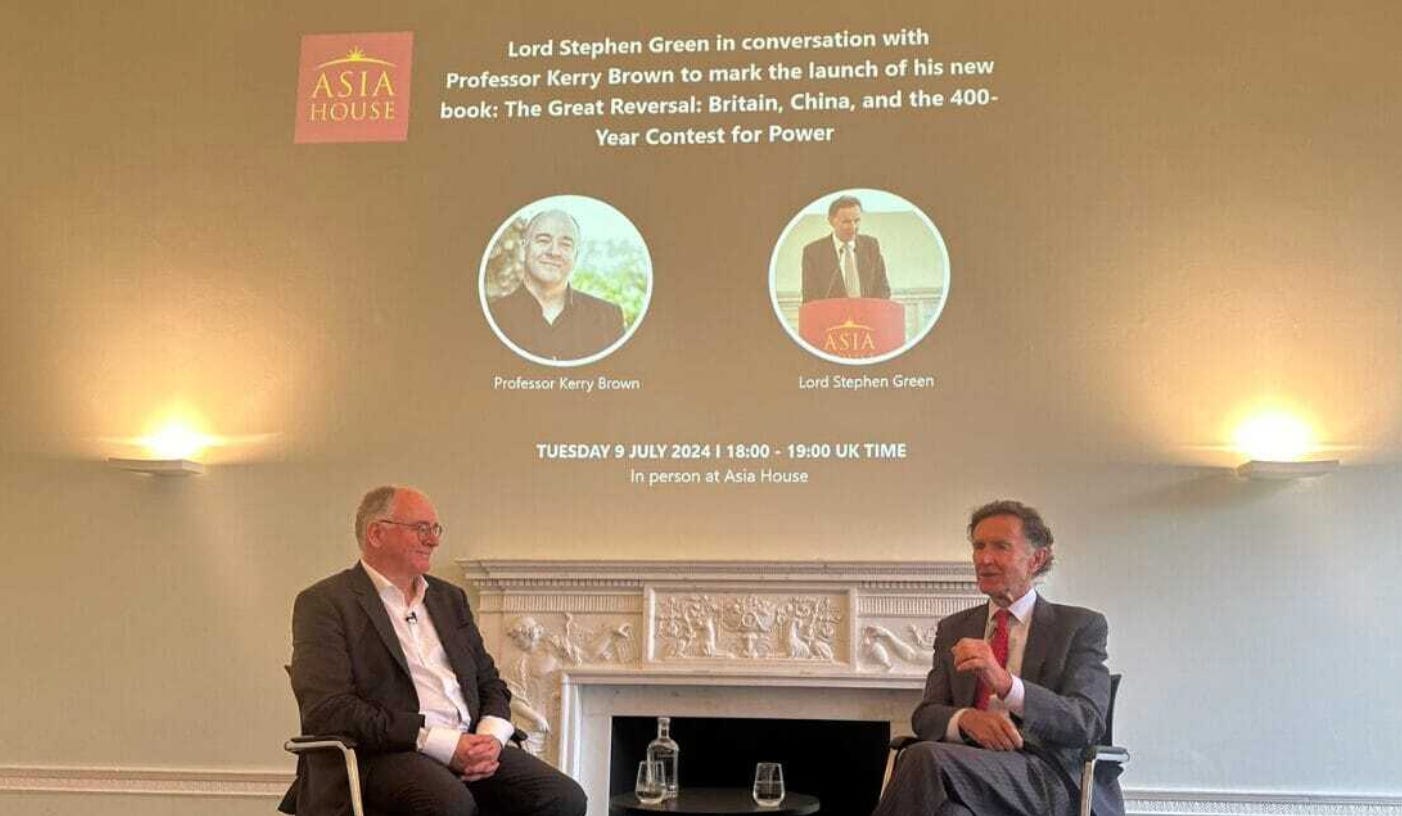
Ruby: This week, UK and China relations are dominating headlines, and you’ve been providing expert commentary on Keir Starmer’s visit to Beijing. But you’ve been writing about this relationship over a much longer arc. And in your book, The Great Reversal, you outlined a bilateral history of over four centuries. I know you’re currently working on a sequel, which looks at the wider relationship of the European continent with China. So if we step back from the headlines and look at the historical context, what have you found in terms of life sciences and medicine that stand out in the relationship with China, and what feels different about where we are today compared to before?
Professor Kerry Brown: What’s really changing is that, in the past, the British and the Europeans had a fairly superior view of their own abilities, compared to China’s technological and scientific and medical ability. We had historians like the great Joseph Needham, who reminded the West that in China’s distant past it was really an important player in terms of science and inventions.
But what we’re seeing today, and certainly on the visit by the Prime Minister of Britain to China, is a great rebalancing, where China has capacity, people, funding and is producing really important new things. And I that has happened very very quickly. 15 years ago, we wouldn’t really have been looking at the absolute speed of China’s ability and the way in which it’s become a research superpower. And that’s creating all sorts of challenges, but it’s also an amazing moment to see this completely new capacity joining the world community. That’s a very big change.
In the past it was often true that Britain was keen to promote itself as a country that was great in technology and great in research. Nowadays, we still have great capacity, but we’re learning to be a bit more humble and looking at ways in which we’re collaborating with the Chinese, where they really have major important innovations and abilities that we just don’t have.
As you’re well aware, universities in China are now really going up the global rankings. Fudan University, Tsinghua University, Beijing University, Beijing Medical University - all are rising almost every year, at a time when Western universities are on the whole either fighting to maintain their position or falling.
That’s just one area in which we see major structural changes, but it’s a story that is going to really accelerate, and every day we have to make sense of China doing something that we didn’t really think it was going to do before. This is exciting but a bit scary.
Ruby: It’s been such a rapid change. When I was in the Foreign Office at the British Embassy in Beijing during the pandemic, so only five to three years ago, when we were delivering on UK China health collaborations, it seemed to mostly be one directional, the UK sharing health expertise to China. But now it seems increasingly it’s mutual or even the other way around from China to the West. And so, talking about COVID as a stress test for the whole world.
2. Impact of COVID
Back in 2020, we wrote a journal article together on the politics and the science of the coronavirus. But we wrote it in April 2020 before we even knew much about routes of transmission, the scientific aspects. Even then, it was so clear how biases and politics tend to overshadow the science. When we look now back at the pandemic, what do you think it exposed about expertise and technical authority and trust in public health, when comparing how different nations and systems acted? And how does that impact how we look at China now, or China looks at us, in terms of trust and understanding, and therefore the potential for collaboration?
Kerry: The pandemic was really the great leveller, because to be honest, no one came out of it looking particularly good. We all had vulnerabilities exposed and that includes China. Towards the end when there was the more infectious Omicron variant, or the protests at end of 2022 against the very serious restrictions, even China was struggling, and people questioned the data about how many did die from the virus there.
Everyone should take the pandemic as a learning experience because we all really struggled and our health systems came close to collapse in many places. We learnt that there’s definitely an issue of trust. China was sometimes explaining things and wasn’t trusted, sometimes it was accused of hiding things - and the West seemed to instrumentalise this issue against China. Trump referred famously to the “China virus” and there was this really unpleasant period when suddenly anything to do with China was a problem, and the place itself was, this great toxic issue, and I hadn’t experienced that before.
It became very difficult for it to feel that this was not just about the politics, there was cultural and even racial issues. That was quite sobering for me, and I think still we’re really emerging from that. Although there are more pragmatic relations now, and Britain has certainly returned to a more balanced relationship with China, all of that left deep issues and caused strong voices in Britain to feel that, in many ways, because of the pandemic and other reasons, we should have nothing to do with China.
I’ve argued publicly that this is not rational. We’ve, as you said earlier, got a long history, Britain and China. We’ve had ups and downs. Xi Jinping yesterday, when he met the Prime Minister Sir Keir Starmer, said something about a turbulent relationship. I guess we know that’s always been part of how we get on with each other.
But despite that, the other thing that we learnt from the pandemic, which has been reinforced by other issues, is that we can’t deal with these issues as nation states. There has to be a broader international response and how we do that, in what way we do it. That’s not easy, but the underlying reality is that any pandemic is not going to respect national borders in the future. And one thing we should have learned from what happened in 2020-2021 is that a more coordinated and a more effective way of collaborating across borders is really important. When the pandemic first appeared, it was very chaotic and there was no real consistency. We can’t have that happen again because the toll not only on people’s health but their mental health was colossal.
Ruby: The pandemic, health and science previous to that were treated as the softer or safer spaces for engagement across borders - and maybe deprioritised because of that, to be something to do when other areas feel more contentious, or perhaps when smoothing of relationships is required and it can be a comfortable place to lean on. But as China’s biotech is shaping economic competitiveness and future disease threats are realised to be tied to security, that distinction has changed so much. And so now health is, as you said, right in the middle of much more hardline topics.
If we’re looking at universities and academic institutions and medical schools getting caught up between political signaling and trying to deliver operationally. Even though health behaves so differently from trade and security, it’s still fundamentally shaped by these wider factors. You work directly on academic collaborations through King’s College London and the Lau Institute, including on medical school partnerships, on nursing training, and you’ve written on this quite recently for Nature as well. How have you seen these academic collaborations across the UK and Europe with institutions in China?
Kerry: They are significant. China is our second largest research partner after the United States. So it’s bigger than Germany, it’s bigger than France. In terms of peer-reviewed we’re producing, I think, 16,000 peer-reviewed papers with Chinese colleagues every year - and a lot of that is in life sciences. Some of it is in business studies and other areas but life sciences and medicine are key areas.
King’s College London has two well-regarded teaching hospitals, St Thomas and Guy’s, and we’ve set up a degree where we teach medicine to Chinese students in Shenzhen in Southeast China, and we do a nursing project in Nanjing.
One of the issues is: what are our common values? And that’s not so simple because in the past certainly, there was an idea that a lot of the experimentation, a lot of the clinical trialling in China was less regulated. I know that GSK and other companies sometimes had issues about how drugs were trialled in China, and there were lots of regulatory and also ethical issues. The Nuffield Foundation had an ongoing project of thinking through what are the ethical parameters to work with Chinese colleagues. In the past that was critical. You remember when a doctor was accused of gene editing and DNA editing. This was something even the Chinese government at the time rejected - he lost his job. But it was a sign that this was an environment where anything goes. I remember an astonishing example, actually of an Italian doctor, I believe, who was trying in Heilongjiang in Harbin to do the world’s first head transplant. And I do remember, the head of our college at the time was a neurologist. I asked him as an expert could you ever think of doing a head transplant and he just looked at me rolled his eyes and said no no no that’s not possible. Now it is much better regulated, and that’s because of a lot of the work that, colleagues like you did when you were working in the embassy.
There is much better understanding of the need for common values to reassure patients. and now, in the Chinese healthcare system, as far as I have had experience of it, when it’s good, it’s world class. It’s really excellent and outstanding. It’s a vast country, so there are massive differences, but in Britain there are also massive differences, so that’s not unusual. I suppose though that we have a probably more embedded sense of dealing with common risks and common calculations of what would work and what wouldn’t work.
Related:

3. Ethics and Rights
Kerry: I don’t think it was a waste of time to think about common ethical principles. One way to see this is that China is not into the idea of universal values. I mean, it doesn’t mind rules and regulations that sort of work for utility. It’s best that everyone drives on the right side of the road, or the left side of the road, rather than trying to mix them up. So you have global rules to make sure that there are common standards, and it just means that things are possible, and that you can stop inconvenience or even catastrophe.
But I don’t think that China buys into this idea that there’s a set of values, like freedom and all the rest of it, are universal and have to be transferred from one society to another. So I think the Chinese roots are a more communitarian approach rather than a universalist approach. the idea of Chinese society being very networked not really buying into the idea of an overarching set of values. China was always quite a hybrid society with Confucianism, Taoism, Buddhism and really more of a of battleground of belief systems. It never had a common belief system like Christianity operated in the West. So I think that lingers - not to say that classical Chinese thinking is not full of rich, profound thinking, and Confucianism is an ethical system - but it’s certainly different in the way that it judges values.
There are issues about why one should do things and what one’s aims are between Western institutions and Chinese ones today. For instance, on the issue of human rights, China would say that it believes their collective human rights are to deliver development for society, as a fundamental thing to make people’s lives better. And that’s true. China eradicated absolute poverty four or five years ago - that’s a huge achievement.
But in the West, we still believe in individual rights, and the power of the individual, know, the great enlightenment sort of view of the world, that the individual is the final arbiter of what is right and wrong for them. And so there’s a fundamental difference obviously on how we view and frame human rights. That is probably something we now are more able to accept: that we’re different, rather than trying to have a clash. In the past, Europeans had a reputation for really believing they could change China. I think today we realise that we just have to accept that we’re different.
But at KCL, we’re now looking more at risk management and not really trying to get dragged into big discussions about the fundamental principles. Just assuming that Chinese colleagues are motivated by the same things as us in the healthcare system, which is to look after people’s wellbeing. As we discussed in the past, for mental health it’s really, really interesting because clearly both our societies are having a massive struggle with mental health. The pandemic was pretty brutal in Shanghai, in lockdowns there. It had a big impact on people’s well-being. in a sense that has also given us a common ground. I don’t know whether the prime minister’s visit will be able to address those kinds of collaborations It’s more difficult, it’s more culturally embedded and bounded, but it’s likely that as China becomes more wealthy and more developed, it is experiencing critical issues where people struggle with their mental health, and so I think that’s an area that we definitely could construct more of a common framework in the future, as we’ve already done with more traditional areas of medicine and treatment.
4. When it works well vs not
Ruby: And in practice, when academic collaborations work well, what does that actually look like on the ground? What types of methods of collaboration align culturally or operationally across the two sides?
Kerry: In 2011 I remember the National Development Commission, a think tank in the National Development Reform Commission, produced a report with the World Bank called “China 2030”. And one of the issues in that was how to develop a modern healthcare system. I did some work at the time when I was based in Sydney with our medical faculty there about what that meant. And one of the issues was moving from, infectious diseases to chronic diseases - cancer and heart disease being the biggest killers.
The premier at that time, the late Li Keqiang, he made a speech about healthcare as a generator of GDP growth. He talked about the new spaces of growth in China that were needing development, because the growth rate was falling obviously as China became more developed. He talked about healthcare very much as a growth generator - so actually, strangely enough, the UK and China align because British universities are capital hungry; they like big paying projects. I’ve discovered that, in even the most benign looking healthcare cooperation, it’s often a very commercial undertaking.
And one thing about collaboration in China is that, within any business deal, people go in with very big ambitions. They think they’re going to be providing a service to 1.4 billion people, and will become wealthy. And then of course reality hits them and they realise it is a very very different market. I remember dealing with an Australian care home provider that was very successful in Australia, and it thought wow there’s an ageing population in China, we’ll be able to set up posts there. And then they realised that the whole system was completely different - the regulations, the funding.
So I’ve learned that it is often the commercial issues that are going to be more challenging and that being realistic about that at the beginning is going to probably frame what you can and can’t do because if you’re going to have a successful project you’ve got to realise it will probably be quite a lot of work, You’ve got to ramp your expectations down and just make it probably what you would try and achieve in Europe or your home territory rather than go into this idea of a massive market in China that just needs to be tapped for you to become super wealthy. I think that lack of realism has been a big impediment over the years
The other thing about China is that it varies a great deal across the country. You’re doing collaboration in one place, like in Shanghai, it’ll be international standards mostly, probably better than we would find in many British places. But if you go elsewhere, it’s obviously very, very different. China is a continental-sized country. It’s literally a world within a world, So I think that that complexity is often very hard for people to navigate and there’s not really the common standards across the country That’s true in other places, but I think in China, it’s very very varied. So it is not easy to make generalisations about working in China. You do really have to know your partner and know what you’re doing and why you’re doing it and that takes a lot of communication and trust-building.
Related:

5. Pressures and operational challenges
Ruby: And then for Western academic institutions, or just institutions, in working with China, are there any pressures back home on how that is done?
Kerry: I think the pressures are public perception. You have to communicate what you’re doing and on the whole, the political environment in Britain towards China is better now. But you certainly do have people wanting to scrutinise what you’re doing, why you’re doing the part you’re doing, and then they’ll make all sorts of claims about there being a problem in China. It is hard to do due diligence in China, I think. It’s often very, very difficult to get access to the records you need. But at the end of the day, if you’re dealing with very prestigious universities like Beijing University or Tsinghua, they have a reputation I don’t think they want eroded, so they’ll usually be the right partners if you can have them.
The other issue in terms of academic cooperation, is whether there can be a clear sense of what you are going to get from it. We’re not into altruism - I think universities are very self-centred. And that’s fine, because it’s a very tough time we’re moving into. KCL has had a good experience with China in terms of students coming here, but that’s obviously changing now. Universities in China are really excellent, many of them, so Chinese students are tending to go to them more often than are coming abroad, and the numbers are coming down. But it’s important to see strategically what you can achieve from China that addresses some of your research or student recruitment needs. British universities on the whole haven’t probably put a great deal of thought into a long-term China strategy. It was always good having so many Chinese students with the international fees but now they’re having to think: how are we knowledge partners; how is that an equal relationship when China - as I said earlier - is so advanced in many areas; what do we think we’re getting from this relationship that works for us, rather than being overwhelmed?
So thinking strategically is really important. At the end of the day though - and it’s true in many areas - the people to people contact is good. It would be good if we had more people going, because I think that opens people’s eyes and creates these dialogue opportunities which is what we need. Of course, there are challenges sometimes with working with Chinese partners for cultural issues. Sometimes politics gets in the way too and administration. But actually despite all of that an enormous amount of very positive collaboration happens between individuals and I think that that’s probably always going to be the case.
6. Europe
Ruby: And is there a distinction between how UK institutions do this with China versus wider Europe or it’s quite similar?
Kerry: I think the difference is that the UK has a massive advantage in the number of Chinese students that have been here who are bridges. That’s been true for 25 years, even if many have gone back or many are in academic positions. I met two cancer specialists the other day, one originally from China who’d come here in the mid ‘80s, and the other who came via America at a similar time, but is now based in Britain. These are internationally respected experts, and they are here in the UK because they came here to study, and stayed. That has given Britain a big advantage, because it wasn’t so common in other European countries.
Also, the fact that we use English has been a big advantage, because most Chinese now do learn English rather than than French or German. And in addition, we still have a good reputation in medicine. I don’t think Britain can be complacent about this though. 25 years ago, as a diplomat, we would go and promote the National Health Service as being a really great model for China. That’s not really the case now. China has an interest in British academics and British expertise but probably less so in British health practices. I think that’s definitely changed.
Ruby: As you’re researching for your new book on Europe-China relations, are there any insights that you’ve gleaned relevant to what we’ve talked about today?
Kerry: Europe has been seen by Chinese as a knowledge superpower. and historically, the European Union members, Germany, France, Britain, when it was a member, there was a lot of technology transfer. And I think it is important to remember that now the situation is that China is producing the technology that we need rather than the other way around, that we do need a kind of framework for that to happen and that doesn’t exist at the moment. I Europe exists as a technocratic kind of entity really, at least the European Union does, and it is really in the business of creating frameworks for things to happen if it’s trade, investment, I think technology transfer is something that Europe’s going to need, It’s an alternative up to a point of America, but not too dramatically. So I think Europeans thinking getting access to Chinese technology is very important.
But the role of Europe as a cultural power in China, It’s still regarded with great respect. And in the new geopolitics that plays well because America is not an easy partner to deal with now and Europe has a potential to be just different to that and have a more pragmatic relationship with China, even though it’s unlikely that it would lead the side of the United States. that’s never going to happen in terms of security. but there’s other areas where they can work probably more deeply than they do at the moment.
Ruby: In bio-pharma, compared to the US with China. tariffs and security legislations meaning Europe becomes an alternative and less risky option at the same time, Europe’s built this reputation of being a regulator to the extreme, this applies more to digital actually, and data privacy and restrictions to the point where it’s been critiqued to actually hinder progress.
Kerry: I think the phrase was that America innovates, ⁓ Europe regulates and China imitates. well, Europeans probably believed that without regulation you couldn’t innovate and therefore it was just creating the infrastructure and the ecosystem that you could magically do things you couldn’t before those rules and regulations were in place.
Europe’s historically seen itself as diverse and therefore creating internal competition that would make people fight to have better ideas. it’s an old idea that why did the Industrial Revolution happen in Europe? Because there was real competition between city-states really and that people like Galileo could go from one place where he was being persecuted to another and be able to continue.
It’s puzzled Europeans for a long time why China didn’t take part in the Industrial Revolution and why it fell behind after an initial history of being a really important scientific power. today you would definitely criticise the European Union as being too much about regulation and that the Europeans are quite defensive. Their posture towards electronic vehicles, EVs, has mostly been driven by the German manufacturing industry that are obviously very uneasy with their export markets for their cars.
So I don’t think Europe was really prepared for a China that was innovating in ways in which it would be very competitive and then extremely able to export into the European markets. And they have complained about over capacity. They’ve complained about China and state subsidies. That’s become a big, political issue. I don’t think Europeans are going to stop regulating.
But they’re going to have to do things in a different way because the whole pattern of their relationship with China now, like with the UK and China, is changing because of this technology issue. And I don’t know whether collectively they’re going to be able to do a kind of deal that Britain would also want to do, a sort of technology transfer deal, because they have such huge capacity. But the last attempt they had to do a deal, the common agreement on investment in 2019 was negotiated for seven years. was relatively good deal, but it was stopped for political reasons. So politics definitely gets in the way.
Related:


7. What China wants
Ruby: What have Chinese stakeholders shared about what they are still keen to learn from UK or Europe? Where do they think the West still genuinely adds value e.g. clinical research or medical education, any topics that you see that there is still interest, respect and eagerness?
Kerry: I think certainly medical education. King’s has set up a joint medical degree in China. There’s respect for that, but I think, it’s becoming more and more competitive. China is producing really important research. It’s got great capacity, its research and development budgets are massive. When you go to Chinese universities they’re well-resourced, they’re impressive and new. Zhejiang University has a massive new campus and last time I went to Chinese University Hong Kong in Shenzhen, also massive new campus. Shanghai Jiao Tong has a big medical faculty as well which is incredibly impressive, just massive.
I think that the story is likely to be what are we going to do to get access to Chinese in innovations and medical knowledge now. I mean I think it’s a a tipping point, my sense. I mean we definitely are going to have to become more competitive, and our mindsets have to change. Because it still lingers, you know, the idea that we are definitely superior in terms of how we do things and educate. Yet every day now, you see that being contested. So that mindset has definitely got to be revised pretty quickly.
6. Learning
Ruby: It’s tough to revise it, right? as a former diplomat and sinologist, you’ve been advocating for nuanced engagement across the East and West for decades and you’ve mentioned the response is improving in the West, but it’s all still relatively outdated, and not nuanced enough. So what does that mean? How do you communicate effectively?
Kerry: The speed of change in Britain is not great. And you can say the same thing 50 times and finally, someone might say, okay, I hear you. I mean, I’m happy that there’s now a more pragmatic relationship, because it makes sense, it’s rational.
I don’t like irrational actions. I’m a realist, you know, so while I understand there are cultural and other issues when you’re dealing with countries with a very different background and a very different history and, maybe a different understanding of their role in the world, which China clearly has compared to Britain. But I think that we just have to be reflective.
There is discontent in Britain. Obviously people don’t have a great experience with their healthcare here. The primary healthcare system is frustrating people, long waiting lists. I think we’ve got to really do what the Chinese do and look around and say, okay, if this doesn’t work, then what does work, and where else can we learn from? And when China was emerging from the Maoist period in the late 70s, it was impressive the fact that they had their delegations go abroad to look at everything - and they did it for a long time. They still do it to some extent.
I think that that’s very praiseworthy - these delegations to come and look at the UK’s devolution, looking at our National Health Service, looking at our educational system. China didn’t necessarily adopt many of the things, and sometimes people thought - well, why are they coming - but I think that there was a lot of reflection and study of what others were doing.
China took some things and ignored others, and I think Britain needs to duplicate that. We need to have a good hard look at other healthcare systems, and the funding of those systems. I worry about how Britain is going to navigate these issues when we can’t afford what we have at the moment: with an ageing population becoming a bigger and bigger problem. China has similar issues, it’s got an ageing population, and I’m fascinated by how they’re engaging with technology, the use of robots in China. I’m fascinated by how that works and what are they going to do about their significant demographic issues? This is all stuff that we should be going to learn from, because in many ways China is a massive social experiment. So why don’t we just look at this and see what we can learn here? There won’t likely be many things that we can learn in the political system because we are very different. But in healthcare or in education, maybe there are ways in which we can learn.
It has to become much more systemic. But you’re absolutely right, changing attitudes and mindsets is a cultural issue, and nothing is harder to change than those cultural issues, because people really cling to them, they’re part of their identity. It takes a real shock to make people reflect on, is this really the right way to do things? There’s obviously real challenges. I don’t know if anyone’s doing it right but I don’t think that we can say we’re a great model, Britain at least, and probably not America. So we are in this period of great levelling where we’re all grappling with similar problems and no one’s got an absolutely great solution. We’re going to have to really thicken our discussion and dialogue to learn from each other and have better routes to learning.
Universities in Britain don’t have obvious institutionalised ways of talking in a very open, frank way to Chinese colleagues about what are our common challenges, how do we deal with them. We do it in a really ad-hoc way, but I don’t think that we do it on scale. And I maybe we’ll start to do that, but that will take a lot of trust building and a lot of openness. To be honest, the fault is as much on Britain’s as was on China’s side. We are probably not happy trying to open our eyes to a very different place and a very different cultural outlook, maybe giving us ideas for how we could improve, but I think we’re going to have to start doing that.
7. Risks of not engaging
Ruby: I guess, as an academic, you’re advocating for a more academic method of learning and understanding! Maybe a strong communication method also is to think about the dangers of not engaging and the more heavy handed risk angle. Whether that’s, as you’ve mentioned, on shared global challenges like ageing populations, rising chronic disease or pandemic threats, or if we are viewing even medical and science collaborations with China as national security risks or competitive threats, then ensuing decoupling. What are the risks of that?
For example, this morning I was reading about how leaders in the Conservative Party have been criticising Starmer'’s trip and saying that if the Conservatives were in power, there would have been no visit by a British Prime Minister. And there was pride in the fact that there hadn’t been a leadership visit in eight years, which I thought was a pretty incredible perspective. But can you share from your experience, and your writing as a historian, what are the risks of not engaging with China on medicine and on health?
Kerry: They’re pretty considerable. Hypothetically, and it’s more likely now than it ever was in the past, some of these amazing start-up companies in the science parks in Beijing or Hangzhou or Shanghai, what if they come up with some really good effective treatment for cancer for instance, or any other sort of significant chronic disease? Everything points to that being more rather than less likely.
At that point, do you maintain this “we don’t want anything to do with them” even if they may have come up with a really great treatment for heart disease or something that really would be hugely important to us, but it doesn’t matter because our values are so important that we won’t even engage in this area? I think that makes no sense, that can’t be in your self-interest.
You’re right, the politicians in Britain are really good, when they’re out of power, of saying that they definitely wouldn’t do anything. And the moment they come into power, then it all becomes very, very different. I think it would be very weird if a conservative party with the current economic issues was still in power, that it wouldn’t look to have some sort of deeper dialogue with China, particularly because the geopolitics now with America becoming very unpredictable, means that you’ve got to basically look after your interests and diversify your relationships even with those that are not remotely or traditional allies.
So the risks of not engaging with China now are significantly more than they were 10 years ago to 20 years ago. It keeps on getting more and more obvious that you don’t really have many options. You can’t give yourself the illusion of choice. ⁓ We don’t have much choice except to work with China.
The anomaly at the moment is that actually, despite the differences on big issues, the things that really will matter to humanity do matter to humanity. China and Britain don’t really disagree on the environment. We both agree there’s a massive problem on AI. We are both concerned on public health issues. We both think there should be priority on nuclear proliferation for different reasons. We are both not keen on massive increases in nuclear weapons, particularly because China’s got four neighbours to the nuclear powers.
So actually on the big stuff, we don’t disagree - which is not the case with the USSR and in the Cold War where there were fundamental disagreements. It is therefore odd that we argue as much as we have in recent years because we actually have more reasons to agree and converge than we have to disagree. And politically I think that it’s not a priority for Britain to argue with the power that we agree with a great deal. It is a priority to be clear about where we have issues and know why we have those and how we can protect those. But that’s a strategic issue, it’s not a of absolutely massive existential issue where you just won’t deal with the power no matter what. That doesn’t make any sense.
Ruby: Starmer has said today that like it or not, China matters for the UK. what do you think responsible, productive engagement looks like when we’re talking about health and medicine and science?
Kerry: I think it’ll be cautious. But it would also be pragmatic in the recognition that Britain’s needs are real. There are a huge number of pressures on Britain, economic, geopolitical and otherwise. A pragmatic relationship where Britain is clear-eyed and has sense of strategic priorities is really important. I think the Stammer visit, well, it’s high-level dialogue, it’s not going to make an immediate impact tomorrow, but at least we’ve got a more open-minded environment in which we are just trying to relate China and what it has to our current needs. I think we hope that will lead to some practical outcomes. A difficult relationship - we’re very different - but at least this relationship is going to be less hackling and hectoring than it was in the past.
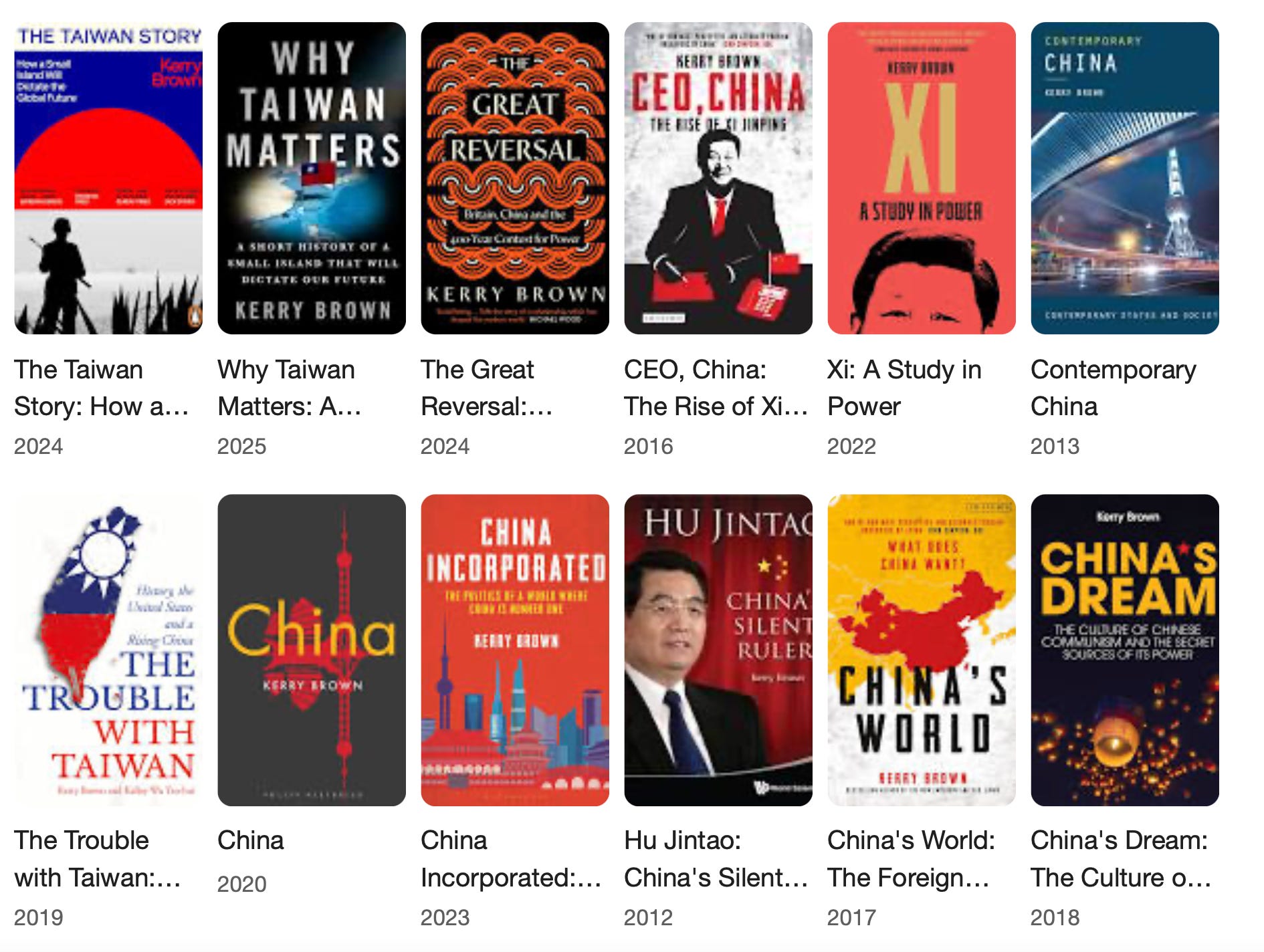
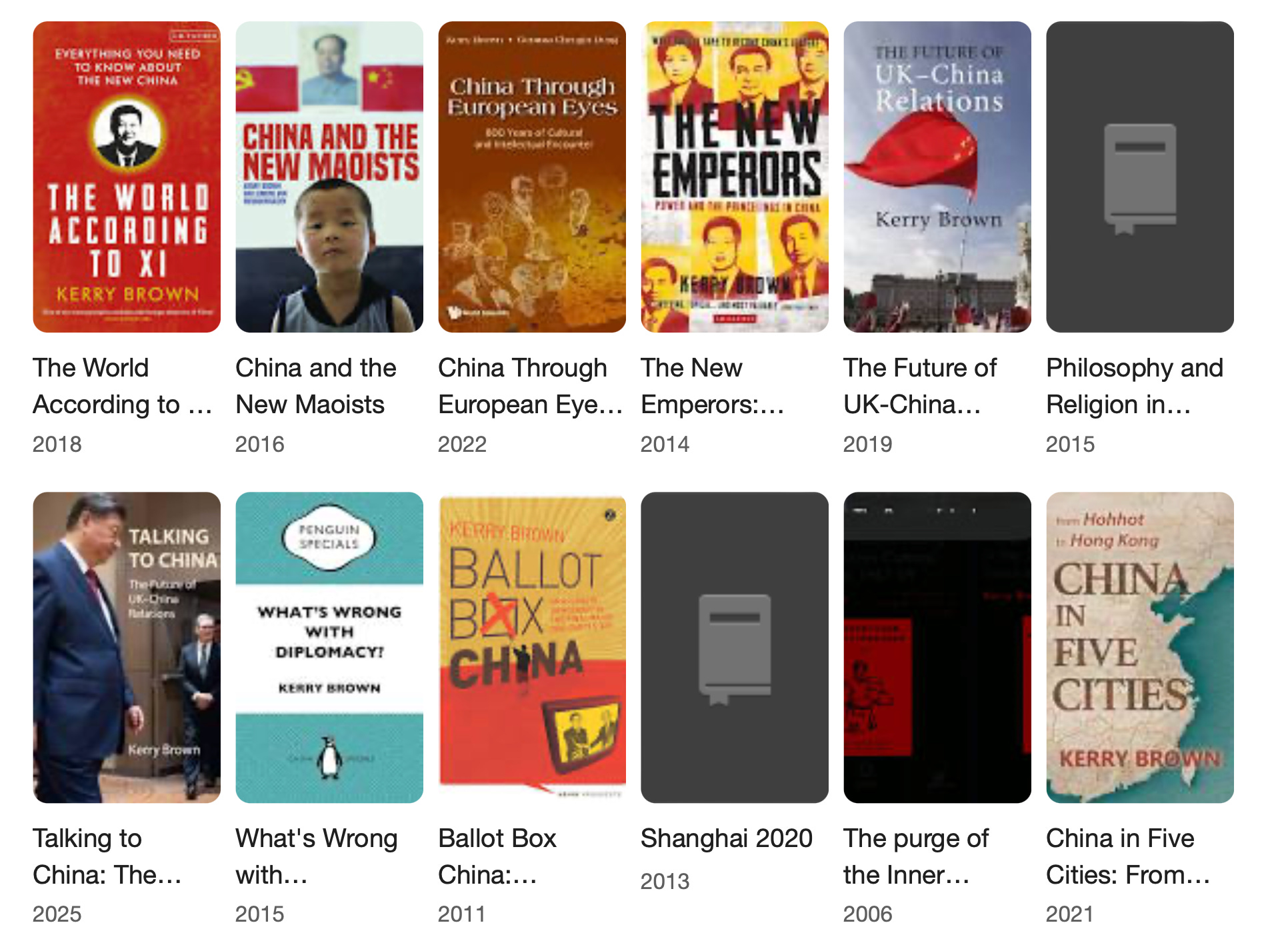
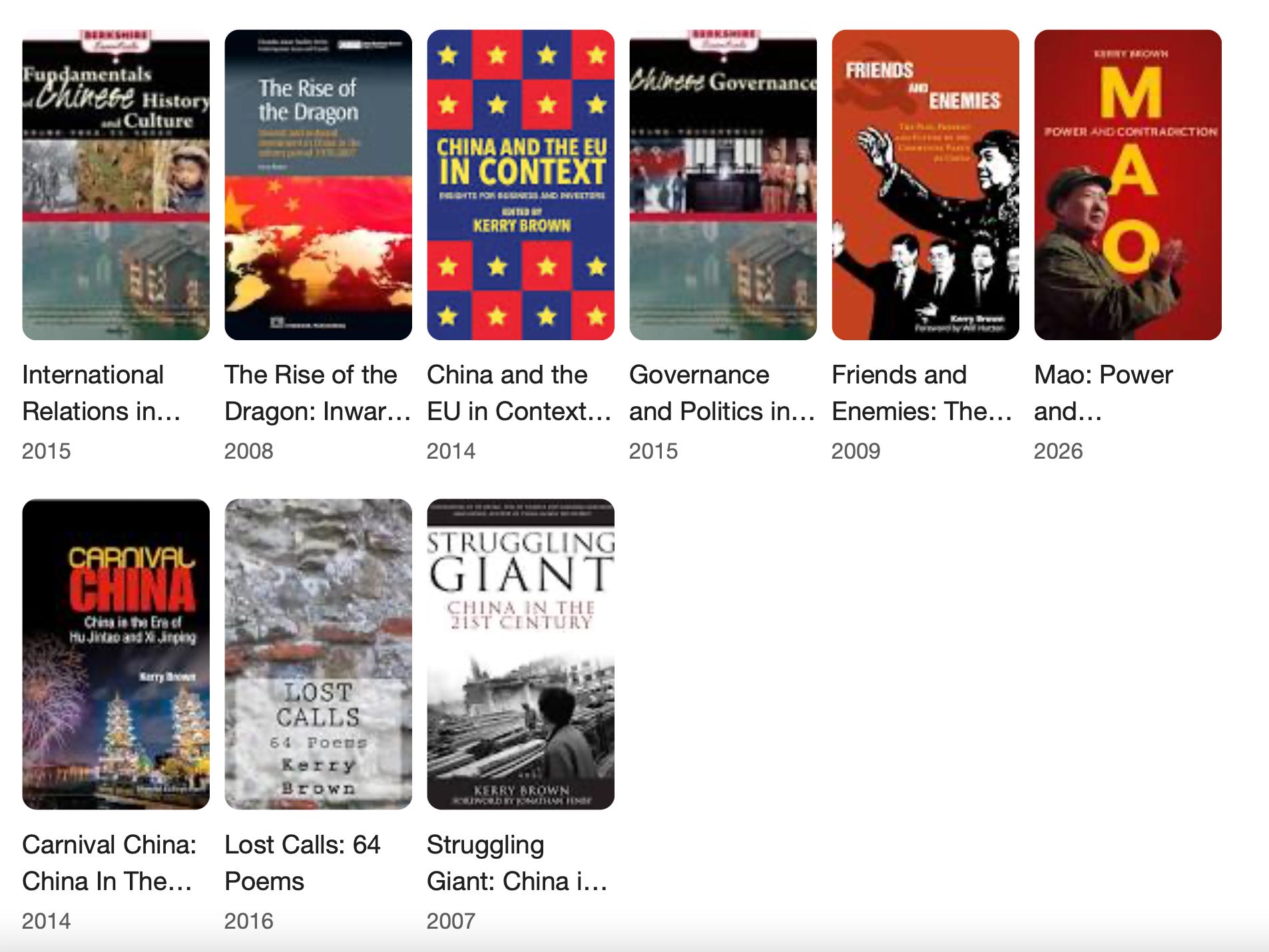
Professor Kerry Brown has written over twenty books on all aspects of contemporary China. These give an overview of the modern development of China’s politics, society, economics, and history. They have been translated into over 10 languages.
Watch or listen here on substack or Youtube, and/or subscribe on Spotify & Apple Podcasts.


