


🎧 Welcome to The ChinaHealthPulse podcast, an exciting expansion of the CHP newsletter, where I chat in depth with the true experts who have dedicated years to working in and with China’s health - across policy, industry, academia and well beyond. Our candid conversations aim to provide you with real insight into how care is delivered, how decisions are made, and why it all matters, far beyond China’s borders.
Watch or listen here on substack, and/or subscribe on Spotify & Apple Podcasts. These newsletter posts provide all links, plus a full text transcript of each episode.
To kick things off, I’m delighted to welcome a very special guest indeed: Professor Tien-Yin Wong is an internationally recognised physician-scientist and practicing ophthalmologist, being among the top 1 % highly cited researchers in the world, leading clinical and translational research, innovation, enterprise and industry collaboration.
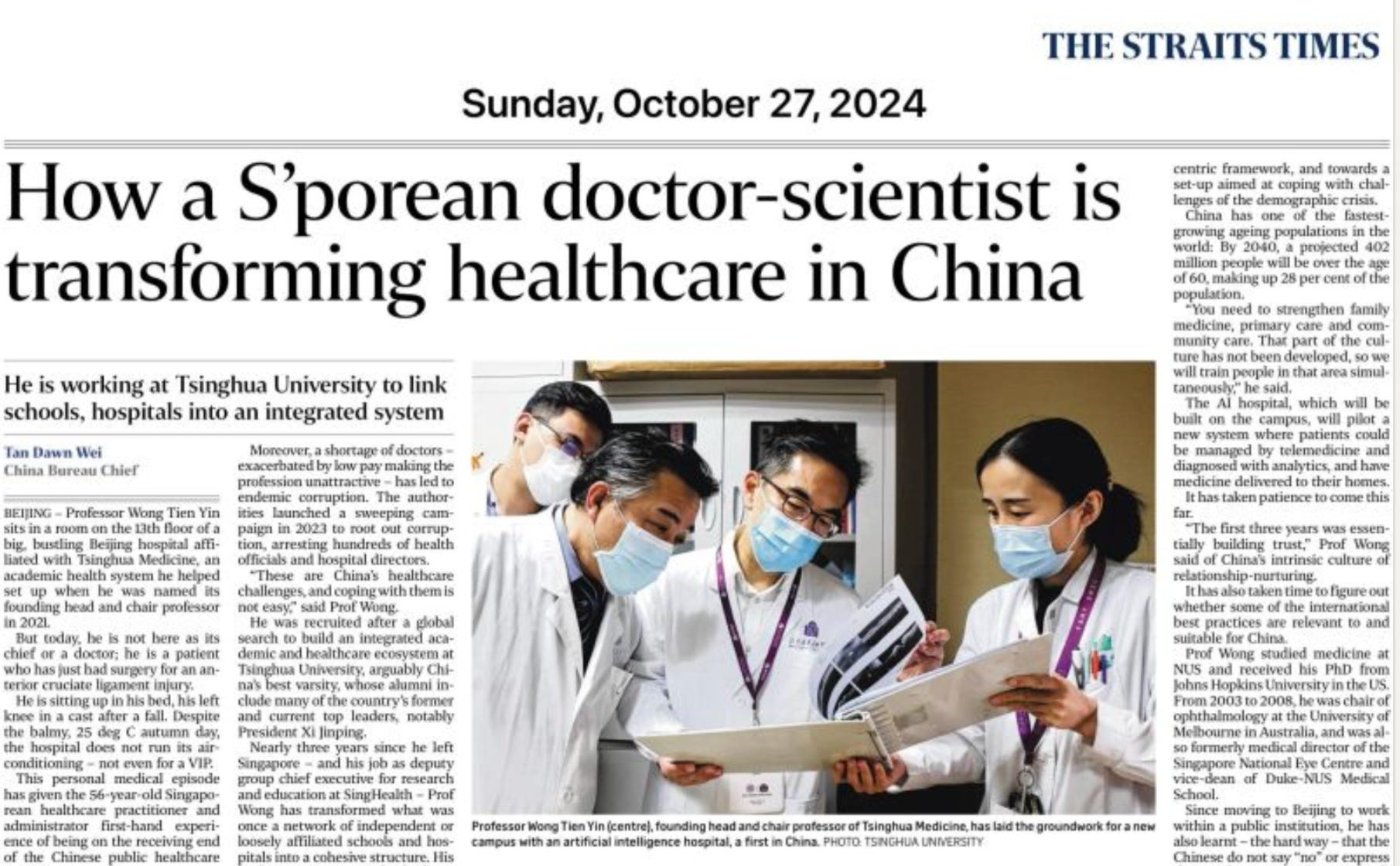
Prof. Wong has trained and worked across East and West: he studied medicine at the National University of Singapore and received his PhD from Johns Hopkins University. Later, he was Chair of Ophthalmology at the University of Melbourne, Medical Director of the Singapore National Eye Center, as well as Vice Dean of Duke-NUS Medical School. He now serves as the Founding Dean and Chair Professor of Tsinghua Medicine, a new academic health system based at China’s top university, where he is leading one of the boldest experiments in health innovation: the creation of China’s first AI hospital.
In our conversation, Prof. Wong reflects on his journey across countries and systems, bringing lessons learned from the US, Australia and Singapore. He shares fascinating insights about the similarities and differences between China’s healthcare system and digital ecosystem compared to the West, how to align across siloed Chinese ministries (the perennial challenge for anyone working in China!), and how he is patiently, yet ambitiously, working to achieve these pioneering feats.
This episode sets the tone perfectly for what The CHP Podcast aims to achieve: conversations with experts who have truly seen China’s health system from the inside, and whose stories can help us understand where it’s heading next.
Watch/listen above, on Youtube, or subscribe to Spotify and Apple Podcasts here:
Read our Conversation:
(Audio transcript adjusted for clarity and flow)
Career
Ruby: Welcome, Prof. Wong! We met at Tsinghua University, where I also studied quite a few years ago for the Schwarzman Scholars Programme. I’m excited to chat to you today in depth about your fascinating career journey. You have had such a wide-ranging path: from ophthalmology, to AI innovation, to now leading in medical education. And you’re the highest ranking foreigner in a university in China! Let’s start there: what brought you here to where you are today?
Prof. Wong: It could be serendipity. You build your career by looking for opportunities, usually at different stages of your career, where you look to do something that can make an impact. So as a physician, it is for our patients and for the wider scientific community. These opportunities come generally in one’s career, every 5 to 10 years - and when that comes, you evaluate whether or not it is a growth opportunity, a developmental opportunity, a challenging opportunity.
Once you have become too comfortable, that’s when the opportunities present new areas in which you are able to stretch and challenge yourself. That’s roughly how I ended up here after many countries which I’ve studied and worked in. Now I’m in Beijing, in China, at Tsinghua University.
China’s health challenges
Ruby: You’ve worked across East and West, and you’ve seen how different countries around the world are straining under shared healthcare challenges, whether that’s ageing populations, rising chronic diseases, and the challenge of how to integrate tech into the system. Now that you’re leading in China, what do you think are China’s major health challenges, how are those similar or different to other countries, and how did that inspire you to address them with potential solutions?
Prof. Wong: China is a very fascinating story by itself and healthcare challenges are both very similar to Western countries in the US and UK, certainly in Singapore and Australia, but also has some distinct differences. The usual similar challenges would be that, as a country develops social economically the rise of chronic diseases such as diabetes, hypertension, obesity, as well as the improving social economic conditions and environment. Then you also have increasing lifespan and therefore ageing population. These two are the most significant demographic and healthcare changes that affect every country. But there are a few differences that China presents and adds on to what are already significant problems that the West are dealing with.
First, the rapidity of the changes in disease spectrum happened over a very relatively shorter period of time (in China) - possibly two to three decades. China’s grown into an economic powerhouse now, but it started from a very low base, So the rapidity of the country’s development that led to a rapidity of the ageing population and chronic disease. In a blink of an eye, China has moved from a young population whereby obesity was not an issue - in fact, nutrition and maybe even providing basic healthcare was the main issue - to now being a very different healthcare spectrum. The rapidity means that the healthcare system is not able to react and adapt quickly enough. That’s the first challenge.
The second is that China is really not a very homogenous country. In Beijing and Shanghai, the life expectancy is probably 83, 84 years of age, which is no different from the most developed countries in the West. But if you move into the Western inner regions, the life expectancy would be dropping, and it could be 60 or 70 years. Even in some regions, it could be 50 to 60 years. China is really not a single country in a single region. And therefore, its healthcare system needs to manage patients that are very old in some of the major economically developed cities, and yet still deal with some of the more, acute conditions that affects the young people in some of the less developed regions.
The third thing that’s very different from Western societies, is the lack in the healthcare policies and the financial models that has supported and that has been developed in the Western societies, including UK, Australia, and of course Singapore, where policies and financing mechanisms has adapted to some of these new diseases. In China, the individual patient and the family has to bear a higher proportion of the healthcare costs, because the healthcare coverage, the healthcare financing or insurance coverage has not yet caught up with some of the changing disease spectrum.
So there need to be changes in the system overall, in how China manages different regions - from very advanced cities such as Beijing, Shanghai and Shenzhen, to what are still predominantly rural regions, where basic healthcare needs updating of healthcare policies including financial models to support this changing disease spectrum. These are very unique challenges for a very large country that is undergoing a very rapid transformation. It’s not easy and I don’t presume that there’s a simple solution to this.
Ruby: Yes, it’s certainly a vast country, a vast population, with very distinctive challenges. It’s very difficult to address them and you have to approach it from all angles.
Related posts:

Transforming Medical Education in China
Ruby: In your work now, you’re really looking at it from two particular angles. One is the skillset of the health professionals and training, and the other is the angle of technology. We’ll look at medical education first.
At Tsinghua University, you were invited to design a new kind of model of medical education. You’ve described this task as the three S’s: structure, strategy and pace. How has this process been, what kind of future clinician are you trying to train, and how should medical education in China evolve to meet the real needs of the health system?
Prof. Wong: Let’s break it down a little bit. There are overlapping, but different pieces, to bringing an overall vision to what is now known as Tsinghua medicine. So these three S’s. The first S is a structure. I was keen to push a new structure in China, which in the West is called an Academic Health Science Center or System: AHS or AHSC. Essentially, this structure involves joining at the hips two very distinct enterprises, creating synergies important for the training as well as the development of physicians to be able able to handle the future.
One is within the university system, which is, traditionally, the schools of of basic and clinical medicine. Where a student is trained typically as a medical student. Tsinghua University is one, in the UK, Cambridge, or in Singapore, the National University of Singapore, for example.
Then the second very important structure, which needs to be joined at the hip, is the healthcare system, or the hospital system. In Tsinghua, this is the affiliated teaching hospitals, of which the most prominent one would be the Beijing Tsinghua Changgen Hospital. This provides clinical care, but also the training and teaching of the careers of medical students after they graduate. In other systems his will be, for example, Addenbrookes Hospital in Cambridge, or the National University Hospital in Singapore.
It means that a single structure is responsible for the training and teaching of medical students when they are young, all the way to the post university or the post school of medicine training into the hospital system where there are young doctors specialist and then consultant. This is quite a long process, and a typical student entering at 18, 19 years of age at the university takes anywhere between 12, maybe even 15 years to become a safe practicing doctor. This cannot be done by a single entity, but it needs to be done under AHS.
So when I went to Tsinghua, I realised that such system really does not exist in China, because the schools and the university typically fall under the Ministry of Education, but the hospitals and the healthcare system falls under the Ministry of Health - and there are somewhat different missions of the university and the hospital system.
So while joining it at hip is important for training and development, it’s certainly not an easy marriage of sorts, because they are under different structures and different governance. Nevertheless, over the last three years or so, we created the first overarching structure that is ready for the future. And that’s what we call Tsinghua Medicine - not Tsinghua School of Medicine, and also not Tsinghua University Hospital.
And that leads us to the second S, which is strategy. This involves bringing together teams, looking at the problems that we’re trying to solve, and then creating a roadmap for that future shared vision. We are now moving along and trying to create that path for our medical students Then, the third S is bring all this together: space. An integrated academic health system should typically be where the University and the hospitals are seamlessly linked, generally on the same site, so that medical students can move from their classrooms to the hospital beds and the operating room, within the single day. This creates the atmosphere for a seamless learning opportunity. The three S’s sound simple, but obviously it takes a lot of work.
Working with Chinese Ministries
Ruby: you mentioned the silos between the ministries and how you were able to coordinate and integrate. If you have any lessons to share, I think that would be fascinating. This is one of the core struggles of China’s health system at large.
Prof. Wong: The two principal beneficiaries of the silos are distinct and yet are very important. The usual Ministry of Education and universities their focus is on students: “we want you to train them as best as you can”. Whether that is in medicine, engineering, law or the arts and social science, that’s the primary mission of a university and the schools. The other aspect would be the healthcare system under the Ministry of Health. Their focus is on maintaining a patient’s health and the population health.
You can see that the stakeholders in the schools and the hospitals are not completely aligned, so you need to align them. We looked at what is needed, and in the medical school, the most important is still ultimately the patient. We are keeping the person healthy, preventing disease, curing disease when we can. Then the medical education is a very critical but basically supporting mechanism, for us to train the manpower and the talents that is able to meet this patient objective.
So rather than having two different objectives, we have aligned them, where the student’s education is to meet the patient’s needs and the goal (at the same time). Then I think it makes sense for the siloed structure to come together to meet this sequential but very important goal of training students who will be doctors, who will look after patients, that will be for the benefit of the population and society. So you streamline the vision. Of course, it’s easy to say it. You know, there are always cultural differences and you do need time to for everyone to accept that there are different roles, but ultimately a single vision and therefore a single mission.
Related posts:


Global-Local
Ruby: How did your global experience in teaching, and in practicing, help you along this journey, to apply it all to the China context? This was a key reason why you were selected for this role, the global expertise and worldview that you bring to the table.
Prof Wong: I think there are three phases of that learning process. The first would be that, in the US where it is quite established, in the academic health systems in some of the major universities, there was a very seamless integration of the school and the hospital under a very similar mission and orientation.
I was a student at Johns Hopkins, where it didn’t really matter whether you’re medical student or a PhD student, if you’re a scientist or a professor or you’re doctor. You belong to the same overall entity. You feel an affinity, and you feel the energy and the vibrancy of this in the US. When I moved to newer systems such as in Australia and Singapore, they also had this culture and this ecosystem. And that allowed me to really understand how do you do it when you don’t have that system.
(In China), we had to create this by again, having that shared vision, bringing people together, trying to find the right common goals, doing the easy task first, always keeping the communications open, bringing teachers and doctors together on very even platforms without attributing success to one or another. All of these are very important cultural changes that need to be done, and you cannot hasten this process, but if you know where we are going and the structure is going, then you can really apply some of the levers and drivers that allows this to work.
So when I had the US (and subsequently the Australia and the Singapore) experience, I already knew what was the final goal. Of course, China has a very different culture and challenges, but nevertheless, it allowed me to at least understood some of the problems that we were going to encounter, what are the workable levers and what sometimes really doesn’t work anywhere in the world.
Future Clinicians
Prof. Wong: We can also really go into a little bit more detail what we want our future doctors to be and how do we train them. The broad aspect is that we now know that a person’s health is not just dependent the cells and the genes that control our biology and diseases, but the entire environment. means we need to know where they live, how do they work, what they eat, what air does a person breathe. These are very important social, economic or cultural determinants of health. And therefore, a broad education of what affects health and what maintains health is very important, because that affects patients and how they either get diseases or recover.
Second would be technology. We are now, of course, in the age whereby technology is both a driver for transformation and innovation, as well as has many other risks involved. And the typical (example of technology) would be AI. we need to expose our medical students and our doctors to how they learn and practice AI, in a new healthcare setting that will be driven by a digital healthcare system as well as a data-driven ecosystem. That’s also a very important part of the mission of Tsinghua Medicine.
Ruby: Yes, it’s very important to think about the role of a doctor today versus future clinicians you want to try to train, especially as tech becomes more embedded in care, and especially as the world changes around us. I started practicing about 10 years ago now, and even at that time, things were so analogue, and the idea of technology, bringing it into the clinical pathway, the patient pathway, seemed very difficult. If you think about the start of your own clinical career, what technology and health looked like then compared to today, it must also be so interesting to see how much things have changed.
Building China’s First AI Hospital
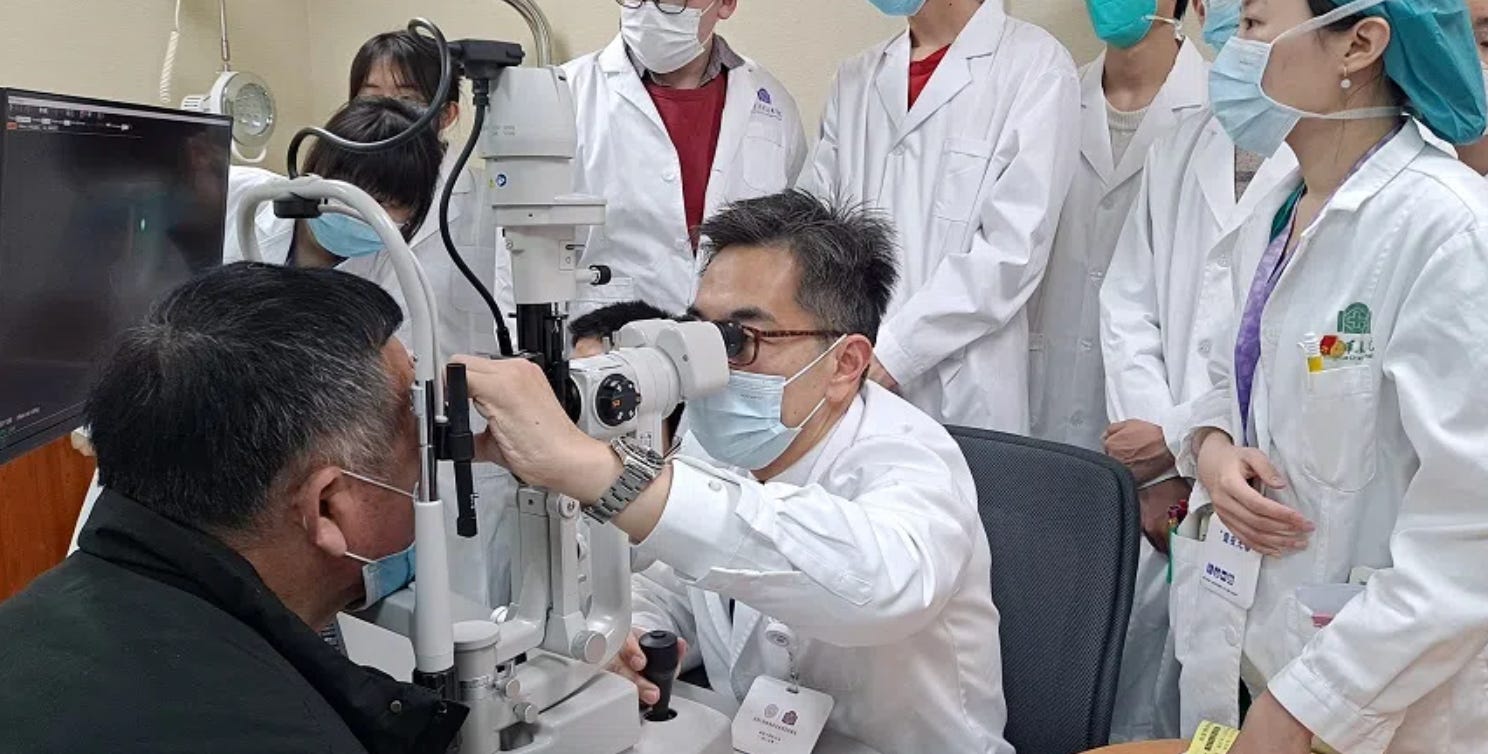
Ruby: Now you’re doing something hugely exciting: you’re building what’s being called “China’s first truly AI hospital” - and at Tsinghua, which is the top academic institution in the country. What does that vision look like for you? And how will it look in practice when it’s completed?
Prof. Wong: It is still a concept that’s evolving and in planning. First, we need to define: what is an AI hospital? Is it just a piece of software in the clinic, or is it a fully integrated system where there are no doctors around?
The second is where we would want to start first, and which areas do we want to address first. One of the major (challenges) which I did not mention (earlier) would be at the primary care level. As China started its evolution of the healthcare system, they focused on training specialists. So there are fantastic and really excellent surgeons, are excellent cardiologists, very good transplant doctors, many different specialists in China. This has allowed many patients with very difficult, even rare diseases to be treated.
But what has been relatively lacking and underdeveloped, is the primary healthcare system. This means that many patients with very simple problems, the cough and colds, fevers, the little injuries - they will have to go to the large tertiary-type hospitals in China. Therefore, with that clinical and public health need, we feel that the first point of entry for the AI hospital would be at the primary care level. That’s the model that we’re developing.
Now, how do we develop it? Well, we use the latest AI technology, generally based on large language models, to curate algorithms that allow patients’ diseases to be picked up, to be diagnosed, to be precisely given advice, and therefore to be channeled appropriately at the primary care level.
We’ve also involved what we call “agents” - a newer concept, but a very important concept in AI in healthcare. The agent is really someone who orchestrates and coordinates care to make sure that the patient is appropriately managed or referred to specialists when they need to be referred.
And then, how does it look? How much hardware does the AI hospital have? We are now thinking about it from the engineering and the construction of this hospital perspective. We feel that it is unlikely to be like traditional hospitals where for a certain size of populations or patients, you need a certain amount of beds, operating theatres and clinics. We would like to map out the pathway for the clinical care first, where the AI agent interacts and therefore some of it will be reduced in terms of the hardware and the size of the hospital. So it will not be such a large physical hospital, providing the same amount of care as a large traditional hospital.
And then, we call it the “2Ds” of the AI hospital. (The first) is the data centre, data storage. Or data management. And the second D is the digital spine, or the digital ecosystem of the hospital. And for that we do need very specialised teams that know how to manage healthcare data in the most safe, secure way in which data can be used for the training of the AI models, and yet protect patient privacy and does not breach the data security issues of concern to many hospitals whenever they start looking at AI. Of course the digital ecosystem does require specialised software that will interface with the patient, likely on their phones or apps, as well as to the physicians, likely on computer screens, on the laptops, or the iPad systems that we are building. So I think the 2Ds, the data and digital ecosystem, is equally important in terms of the AI hospital.
Finally, I want to go to why are we doing it all, without there being a clear roadmap. The first is that there isn’t such a thing as a clear roadmap. If you ask many groups, there is an interest to incorporate AI into existing healthcare frameworks, existing hospitals. We find that that’s generally challenging, and not easy to do. We have taken the approach to build it from ground zero. In other words, without any substrate to begin with. Many healthcare system hospitals want to integrate or incorporate AI technology into existing structural foundations of a traditional hospital. That’s not that easy to do.
If I were to give an analogy, it is really like a renovating an old house with new digital wires and ecosystem, versus building the house from scratch, essentially. And we’re doing the latter approach. Building the house from scratch is what Tsinghua is trying to do for its AI hospital. It’s still very much in development, and I hope that the lessons that we’ve learned in building it will be useful for different countries and systems trying to build their own AI healthcare infrastructure.
Ruby: Staying flexible and adaptable for your forward-looking roadmap, that’s really important in health because some challenges you can predict, but the system brings up new ones or when things overlap that you need to navigate around. Also, China’s ecosystem changes so quickly that you cannot stay rigid - you have to adapt as you go along the way.
Related posts:

China’s Distinctive Digital Ecosystem
Ruby: You’re able to build something so ambitious in China, because its digital health ecosystem is maturing at a much faster pace than many other countries around the world. Part of that is because society and daily life is much more digitised, whether that’s payments, travel, e-commerce. But part of that is because China is so much more open to other challenges that other countries might struggle with, such as privacy or governance.
Can you relate what you’re building to China’s internet hospital ecosystem that’s already expanding? We’ve seen with the rise of DeepSeek and other AI chatbots in China, they are doing pilots at regional level at very small scale, but not yet integrating AI into a offline-to-online (healthcare) pathway. Building AI into the entire hospital framework is so ambitious, Can you share a bit more about that?
Prof. Wong: I think all these are very good questions. I don’t suggest that we have all the answers. We have set out almost a moonshot project, with an aim and a declaration for a common goal, which everyone needs to work towards early on. Rather than building small little pilot pieces and clobbering them all together, we have set up the major goal first. So we think that that is a very different approach from many hospitals, trying to integrate various types of apps and software algorithms.
Some unique characteristics of China make it a suitable country (for us) to do this. As we have already mentioned, the rapidity of China’s digital ecosystem that started being embedded and integrated into everyday life, it’s much earlier than many countries. I see now, for example, in UK that many payment systems are also digital. Transports are also digital, so that’s a good sign. But in China, some of these began maybe 5, even 10 years earlier. There are very mature systems, super-apps that integrate people’s communication with their transport, with their social media, and the way in which they do payments.
Because of this, many people, particularly older people, are much more acceptable of digital technology. In many Western societies, the younger generation is very comfortable with phones and apps and are quite capable of understanding and using digital technology, including AI. But older people would be a little bit more skeptical and may make it difficult for AI hospitals to work, that still want to see the doctor and wants to interact with a person at the end of the consultation and so forth. But in China now, the young and old are equally acceptable of digital technology, which means that the older patients could trust an AI chatbot giving advice, providing a plan and following up with that plan, rather than in other countries where they might question the validity or distrust the AI, and that really hinders a lot of the development. So I think the population in China is very ripe for major technology including AI.
China’s relatively top-down approaches to this means that when the government is very keen to support, they roll out schemes, they roll out incentives, they encourage the healthcare systems to quickly adopt and to use and to integrate. With this kind of leadership, and very consistent messages from China’s government - which is not seen in many Western countries, (who do not have) a single coordinated message, I think it’s very difficult for Western institutions) to say, do we do it or do we wait for the government to give us a clearer message?
In China, it’s a simple clarity of that message, which is that they would like AI and technology to really revolutionise and uplift the entire healthcare infrastructure, as well as the other parts of the society and economy. And therefore, I think the chance of success is higher in China, maybe sooner in China than other places. We’ve seen this in the three areas that China is now currently a technological leader globally: electrical vehicles and probably the autonomous vehicles, new clean energy solar panels, and the ability to manage climate and environmental changes.
There’s a very clear and consistent message from the government, it filters down to provincial and city leadership, and then if it filters down to the next level of leadership at the hospitals, the whole country moves in that direction. So I think similarly with the AI Hospital, I think it will have a higher chance of success because of this singular vision and pathway that is being undertaken.
Related posts:

Risks
Ruby: What are the risks you’re most cognisant of? whether that’s speed, access and inequalities or governance, privacy.
Prof. Wong: All those things are very important. China always balances the speed of innovation and the speed of progress with the ability to bring society along. Because once you have started, you need to) get the buy in from a vast majority of the population. For example, certain segments of population benefit from AI technology and the AI hospital of the future. But (if) the rest of the population does not benefit, then I think the risk will splinter the country. The speed of it, the equality of the major cities versus the less developed and less well-resourced cities and provinces. that’s also important.
Then, the patient’s benefit needs to be first. The first principle for physicians, as everyone would be aware, is first do no harm. The risk of using AI, it’s not so much the benefit of how many hundreds or thousands or millions, but the possibility of harming even a single patient. So healthcare and medicine, and therefore AI in healthcare and medicine, faces this very important high barrier. AI should do no harm. And if it doesn’t, if it’s not able to meet it, then I think (it needs to be) a little bit slower, with a little bit more patience, more safeguards in place. This would be a very important strategy, whether for AI in general, in medicine, or the AI hospital we are trying to build. That balance of pushing technology innovation, as well as protecting the individual patient, making sure that no harm is done to that patient, it’s very critical.
Ruby: The pace and the scale that China is building - and what you’re building within China’s system, leading the way - is unprecedented. For me, sitting here in London, integrating technology into the health system, it’s talked about, and I work on it, but it’s slow, and there’s so much resistance, due to the various reasons you’ve discussed: bureaucracy, attitudes, operational issues. It’s truly incredible to see what China’s doing, and to think about the lessons of what to do and what not to do, that other countries can learn from.
Global relevance
Ruby: You’re now building partnerships between the work you’re doing in China with the UK, with Singapore, with other countries. Building those collaborations - how has that been, to match the strengths of each side?
Prof. Wong: I think China needs to be a leader in innovation and in healthcare, not just for its own population - of which they have many challenges within its population and which we have just discussed - but it needs to be able to provide road maps for a broader population beyond China’s border.
China is a big country, but it’s still only 20% of the world’s population. So I think China being where it is today, must be a responsible and proactive citizen of the world, providing solutions, innovations, supporting the development of population and global health at a broader scale. And I think at Tsinghua, which is, China’s leading university, it’s ambitious and globally impactful - we have a responsibility. We need to build partnerships with places that we can work with, to find some shared vision, identity, shared problems, shared solutions.
Reflections
Ruby: You’re wearing so many different hats: you’re a practicing clinician still, a researcher, Dean and academic leader - and you’re continuing to build bridges across countries, How do you balance all of this, and what motivates you to go in one direction, or another - or all of them?
Prof. Wong: We have to follow very fundamental basic principles. You need goals and vision. You need to set it flexibly, adaptive to the current system and the current situation you can work in. The second very important attitude is to be always grateful and thankful for many opportunities and doors that’s open and to create or to play a part in some journey that’s the larger mission of society.
And I think the third is to have this attitude of always learning, whether it is success or failure, we learn from both. That is a very important attitude. I think that gives you balance, perspective of your role at different stages of career, at different times that you are younger or older and really trying to do something. That helps, if not larger populations, at least individual people, individual students, individual patients. I think sometimes those are very important to really hold on to. It really gives you the ability to balance and to put things in perspective.
I hope you enjoyed this first CHP podcast, as much as we enjoyed recording it. Subscribe on Spotify & Apple to stay updated.
In my next CHP post, I’ll zoom out to explain what the wider landscape of China’s digital health ecosystem is like currently, how internet hospitals have evolved nationwide, and why it’s all so far ahead of the digital health pathways that currently exist in other countries.


