


Please get in touch if you would like to feature or review my book in media platforms, podcasts and events.
Dear readers,
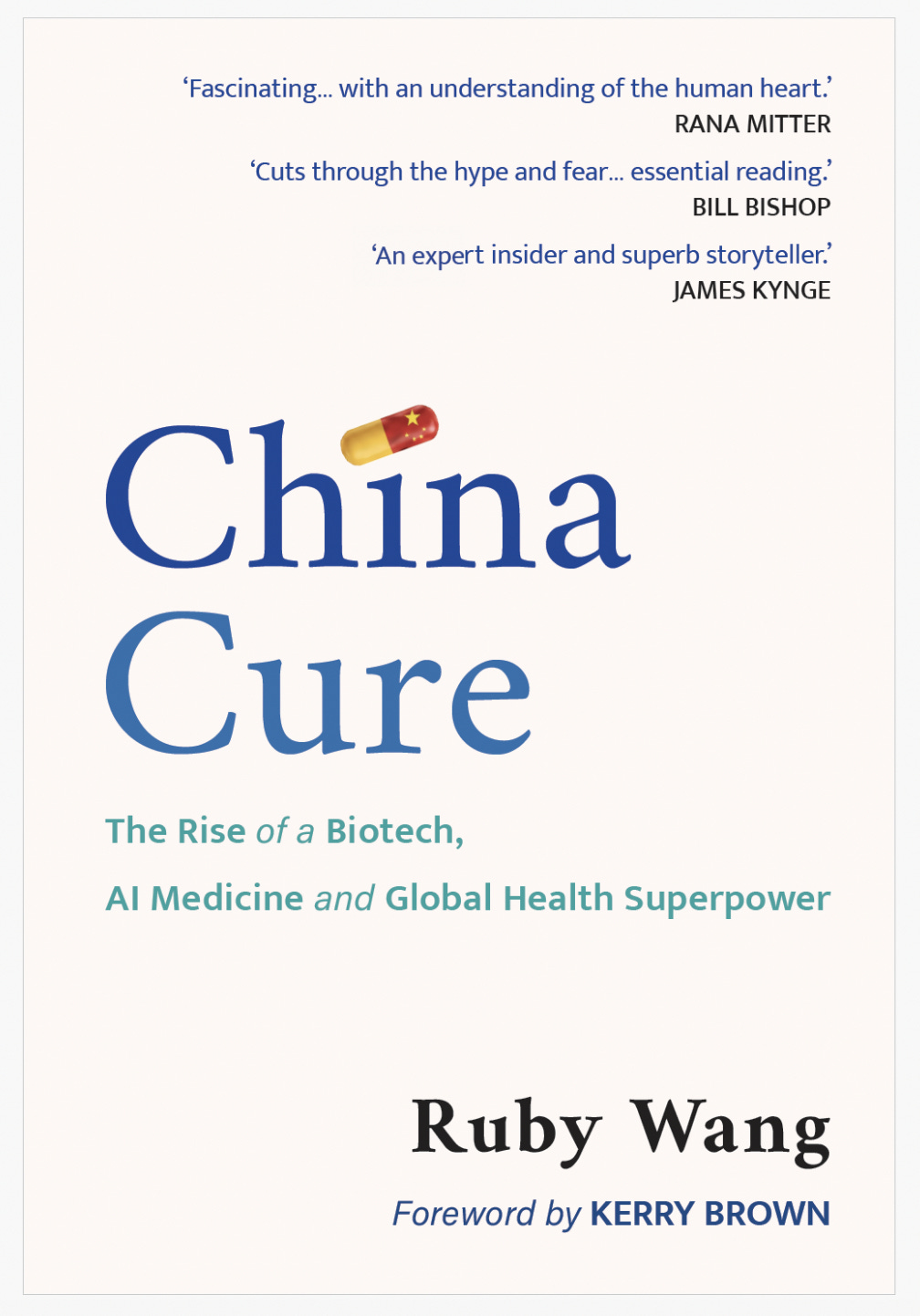
I am delighted to share that my new book, “China Cure: The Rise of a Biotech, AI Medicine and Global Health Superpower”, is now available everywhere for preorder - through bookshops and online (links below).
This book brings together a story that is usually told in separate pieces: China’s rise in biotech, AI medicine and digital health; its growing influence in global health; why these shifts now matter for economics, security, geopolitics and healthcare far beyond China, for patients, businesses and governments everywhere.
These have been the questions here at the heart of the ChinaHealthPulse newsletter and podcast, where I continue explore new developments as they happen, but China Cure brings them together into a single, longer account.
There are already stacks of great books out there on China’s politics, economy and technological progress, as well as many excellent volumes on global health, AI and the future of medicine. Beyond the bookshelves, there are also highly detailed industry and think-tank reports on pharmaceuticals, health security and strategic risk — some of which I have contributed to myself.
But an accessible book that connects all of these worlds in one place, or explains why China’s health innovation rise now matters to all of us, wherever we live and work? that did not yet exist.
So I decided to write my own.
I have spent my career moving across many of the worlds the book explores: clinical medicine, government and health diplomacy, global health and development, biotech and pharma, digital health and start-ups. That has given me the chance to see the same changes from very different vantage points — from hospital wards and policy meetings to company boardrooms and cross-border strategy.
China Cure is the first general-audience book focusing on this complex and fascinating space. And it is also my first book! Having been a voracious reader for as long as I can remember, writing a book of my own has been a long-held aspiration. The prospect of seeing it on bookshelves soon is enormously exciting, and I am deeply grateful to the many mentors, readers, colleagues and supporters who have helped along the way.
Endorsements
I am honoured that some of the China and health experts I respect the most, have so generously endorsed this book, including Kerry Brown, Rana Mitter, James Kynge and Siddharth Chatterjee, as well as:
“Ruby Wang offers a timely and incisive guide to China’s rising medical power and its international reach. This is a much-needed book”
Joe Studwell, author of How Asia Works and How Africa Works
“China’s emergence as a global leader in biotech, medical innovation and AI-enabled care is one of the most consequential transformations shaping our world today. Its effects reach far beyond healthcare, reshaping economic competitiveness, technological leadership and geopolitical power. Ruby Wang’s book cuts through the hype and the fear; it is essential reading for anyone seeking to understand these remarkable changes.”
“China is now a force to be reckoned with, especially in biotechnology and AI, with implications for patients and health systems everywhere. Ruby Wang is an exceptional guide to this transformation, uniquely combining clinical insight, policy experience and a deeply personal understanding to make this book compelling and authoritative.”
Dr Peter Singer, Professor Emeritus and former Special Advisor to the World Health Organization Director General
“Health is no longer the concern of hospitals and health ministries alone; it has become a matter of diplomacy, economic security and modern statecraft. Drawing on rare personal and professional experience across medicine, diplomacy, policy and business, Ruby Wang provides an authoritative account of why China’s global role in health has become one of the defining geopolitical issues of our time.”
Ambassador Craig Allen, former President of the US-China Business Council
Why I wrote this book
CHP readers will already be familiar with the argument that runs through much of my work: healthcare increasingly matters far beyond health.
COVID-19 exposed the strategic importance of medical supply chains and the vulnerabilities created when countries cannot secure the medicines, equipment or expertise their populations need.
Biotechnology has become an arena of industrial competition. Medicines, health data and AI now sit inside debates about economic and national security in Washington, Westminster, Brussels and elsewhere.
And as Western development funding retreats, China is now playing a larger than ever role in how health systems across the developing world are financed, equipped and supported.
At the same time, China itself is still too often discussed in black and white: success or threat, opportunity or risk.
Through my consultancy, LINTRIS Health, I work with governments and think tanks, investors, biopharma and healthtech companies, and international organisations. They come to the table with very different priorities, but they often ask some version of the same questions:
What is happening in China? Why is it happening? And what does it mean for the all of us?
To answer, my instinct is always to step further back. I believe that, before trying to solve a problem, we need to understand the context and nuances of how it came into existence: the history, incentives, institutions, commercial pressures and political choices behind it. And in healthcare, we also need to ask who ultimately experiences the consequences.
A multibillion-dollar licensing deal (if it is not blocked by geopolitics or cross-border issues) may eventually become a life-saving medicine that someone receives, waits for or cannot afford. An AI health platform (if the regulations and ethics stand) may become continuity of care for a patient living hundreds of miles from a specialist, or someone too stigmatised or isolated to seek help in person. Those outcomes depend on regulation, evidence, economics and trust.
These are all reasons why I began this newsletter and podcast, and I will continue to explore these topics here, but the format of a book offers the space and structure to do something different, and exciting.
Long-form writing makes it possible to step back from the latest deal, policy or geopolitical dispute, so that we can look in greater depth at the whole, to better understand its parts: how China moved from importing Western medicines to exporting biotech innovation; why digital health expanded so quickly and how patients, doctors and health systems are responding; how state policy, commercial competition and global health needs interact; and why the consequences now reach far beyond China to all of us, everywhere.
Telling the story through people
I wanted the analysis to be rigorous, but the storytelling to remain accessible.
China Cure moves through the places where big, high-level problems are felt on the ground: hospital wards, family conversations, factory floors, embassy meetings and company boardrooms. The book draws on my own work across clinical medicine, government and health diplomacy, global health, biopharma and health technology, as well as the healthcare journeys of my family between China and the West.
Twenty years ago, when my grandmother developed advanced cancer in Hangzhou, my family fought to obtain an extraordinarily expensive Western drug that helped save her life. Today, Chinese companies are developing cancer treatments that Western pharmaceutical groups are competing to license, and Chinese-origin medicines are beginning to reach patients around the world.
My mother’s experience tells another part of the story. Living in Britain, she has increasingly looked to China for parts of her care, including advanced imaging, surgical technology and digitally enabled services, because of differences in speed, access and the technologies available. Her choices reflect a much wider change: China is no longer simply catching up in health technology. In some areas, patients are encountering tools and models of care there that remain less embedded elsewhere.
And during the pandemic, I moved from treating patients in London to leading the UK government’s health team at the British Embassy in Beijing. Much of our work at the time assumed that expertise and best practice flowed from the West towards China. That direction now looks far less certain.
Through these personal stories, I hope to show how rapidly China’s role in health has changed, and why that shift now matters for scientific competition, commercial strategy, health security, global influence and the care patients ultimately receive.
What the book covers
China Cure begins with the crises, cultural forces and political choices that created China’s modern health system.
It then follows the country’s scientific and biotechnology rise; the development of digital health and AI medicine; what that innovation has meant for patients and doctors; and the institutions, companies, investors and policymakers that determine what scales and what stalls.
The final part looks outward, at China’s growing health role across borders and at the gap that can emerge between perception, policy and what actually happens on the ground:
For Western countries, China’s rise raises questions about pharmaceutical competition, scientific leadership, supply chains, economic prosperity and national security.
And across Africa, Asia and Latin America, the calculation can look very different. Chinese medicines, technologies and infrastructure may offer more affordable and scalable options at a time when many traditional donors are pulling back. They also raise questions about evidence, regulation, data, local capacity and dependence.
I hope this book can show readers just show how dramatically China’s role in health has reversed in such a short time, and why that shift has become so important not only for who develops new medicines, who controls critical technologies, how countries manage health security, but what care ultimately reaches patients.
I have tried to resist easy conclusions; the book does not present China as a model to copy, or reduce its rise to a threat to contain. Rather, its aim is to explain the progress, failures, incentives and tensions clearly enough that readers can better-understand, and therefore make better-informed judgements, about what these changes mean, and what is to come
Who this book is for:
I wrote China Cure partly for people working across healthcare, biotech, health technology, investment, policy, global health and China.
I also wrote it for anyone who keeps seeing headlines about China’s scientific and medical rise and wants one accessible account of what is changing, why it is so important, and how it may affect their own work, health system or lives.
We should not need a medical degree, a policy doctorate or an industry report to understand a transformation that is already affecting patients, companies and governments around the world.
How to get your copy:
China Cure is now available everywhere for pre-order.
Global: Amazon, or at your bookshop (ask for China Cure/quote ISBN 9781788219549)
UK: Foyles, Bookshop.org
US: Barnes & Noble, Columbia University Press
Pre-orders help publishers and booksellers assess demand, decide how widely to stock it and give it a better chance of reaching readers beyond those who already know my work.
Over the coming weeks and months, I will be sharing extracts and more details of in-person events in the UK, US and beyond - watch this space!
Please get in touch if you would like to feature or review my book in media platforms, podcasts and events.
Thank you, as always, for supporting CHP and being a part of this community!
This is awesome! Looking forward to reading it
I count five notable names on the cover alone!
Congrats, Ruby.