


Hello CHP readers,
Happy autumn to each of you - our community now stretches across more than 70 countries! 🍂 I hope you are staying warm and settling well into my favourite season of the year.
I always think of this season as one for sharper air, clearer thoughts and settling indoors with good reading, so it feels like the right moment to share some highlights that have caught my attention recently, on China’s health.
Here are my latest curated reads, listens and links. This edition focuses on AI x Health, drawing together stories that show where the debates and policy shifts are heading. I’ve included English-language sources for accessibility, as usual, alongside links to Chinese government releases or state media where the detail matters most - as well as some excellent analysis by fellow Substackers.
Do let me know what you think, and share what you’ve been reading, too.
AI x Health
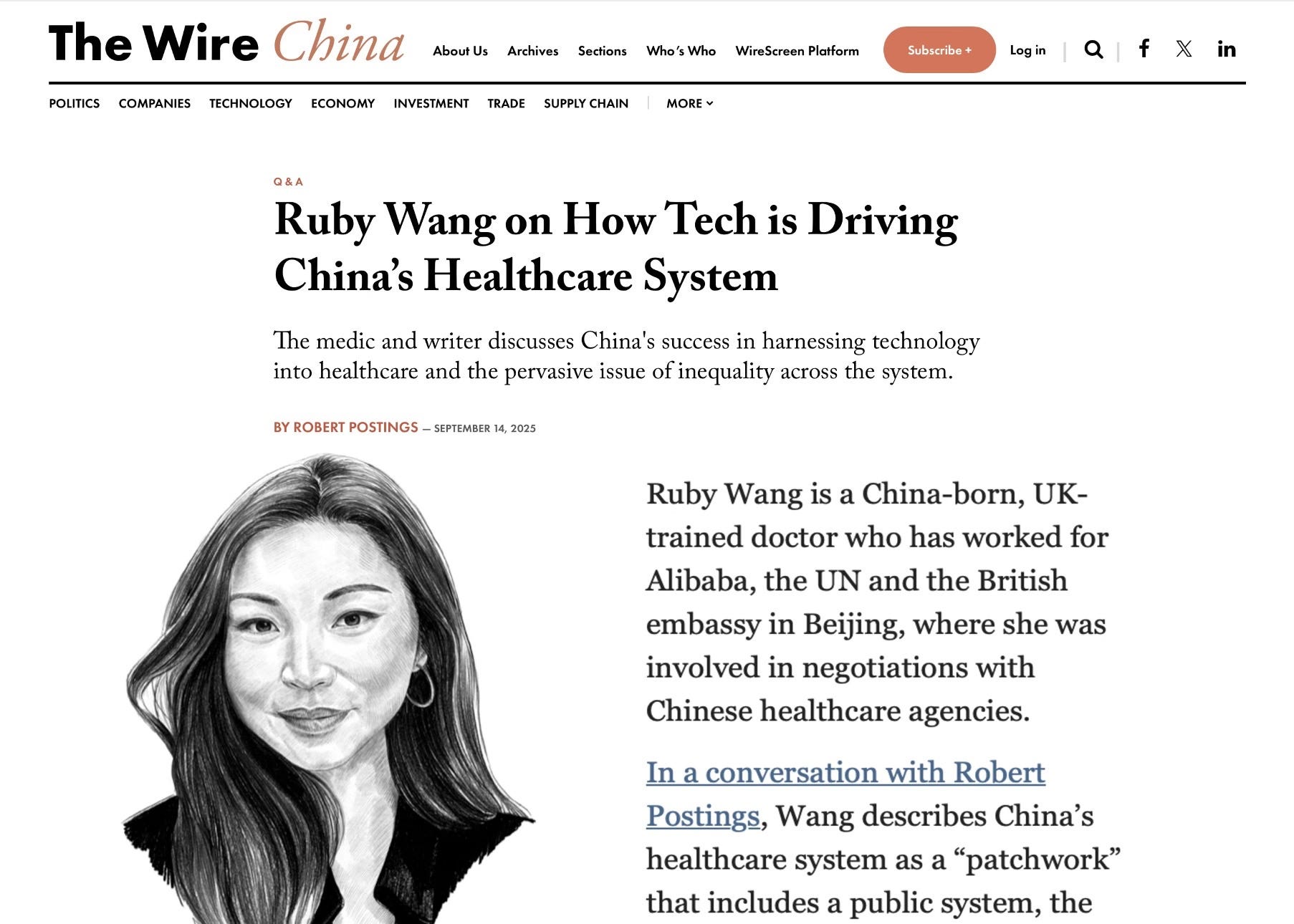
📰 How Tech is Driving China’s Healthcare System: Q&A with Ruby Wang - Robert Postings, The Wire China, 14th Sept 2025
As part of The Wire China’s Q&A series, I talk through how far China has raced ahead in health–technology integration. Long before Covid, platforms like AliHealth and Ping An were already changing how patients accessed care, but the pandemic pushed digital from acceleration to inevitability. Today, Chinese patients can expect to manage the entire journey on their phones, from booking and prescriptions to payments, while Chinese hospitals are redesigning services around apps as their main front door. China is normalising a model most other health systems are still debating. It shows what’s possible when technology is built directly into the core of healthcare- at a scale and speed that is unmatched globally.
Related:

📰 My Mom and Dr Deepseek – Viola Zhou, Rest of World, 2nd September 2025
This piece provides interesting anecdotal insight into how large language models are already seeping into everyday healthcare in China. Reporter Viola Zhou shares how her mother finds DeepSeek to be more humane and attentive than real clinicians - feeding test results follows its detailed medical advice. Doctors reviewing those interactions warn of dangerous errors, but for many patients, the key is trust, not accuracy.
The Great AI Divide: Why China Embraces What the West Fears - Natalia Cote-Munoz, Artificial Enquiry Substack, 16th Sept 2025
A very good piece by Natalia Cote-Munoz on “the great AI divide” between China and the West. She asked users on Chinese platform Red Note how they view AI - and many were genuinely baffled by Western anxiety and fixation on corporate control, job loss, surveillance, and creative disruption, all often framed through dystopian futures and corporate doom. Instead, in China, AI means relief from exhausting work and a natural extension of tools like WeChat and Alipay that have already reshaped daily life for billions of users. This “experiential prior” makes advanced technology in China a story of empowerment and convenience, normalising large-scale disruption as positive transformation. As the author notes, when people have lived experience of technology improving their lives through state-coordinated development, they’re more likely to be optimistic. And this optimism helps explain why China has been quicker to bring AI into clinics and hospitals - transforming health experience and delivery in a way that is still unimaginable to much of the world.
China Releases “AI Plus” Policy: A Brief Analysis - Geopolitics Substack, 27th Aug 2025
A nice summary by Geopolitechs of a major policy upgrade, setting out how AI will be China’s growth engine. In late August, China upgraded its old Internet Plus strategy into AI Plus, shifting from “connection” to “cognition” : 70% adoption of AI agents and devices by 2027, 90% by 2030, and a fully “intelligent society” by 2035. The policy spans six areas: science, industry, consumer apps, public services (including healthcare), governance, and global cooperation. For health, it promises nationwide AI assistants, smarter diagnosis and insurance services, and big pushes in elderly and primary care. Reading between the lines, this roadmap helps to tell us where pilots, budgets and opportunities will land in China over the next 5–10 years - do get in touch if you’d like health sector-specific strategic analysis on these implications.
Nvidia and China; EU and rare earth magnets; US-China; Xi praises work on 80th anniversary commemorations - Bill Bishop, Sinocism Substack, 17th Sept 2025
Bill Bishop breaks down this breaking news story in his always excellent Sinocism newsletter. He points out the ambiguity: is Beijing banning all Nvidia AI chips, or just the hobbled export-control versions such as the H20/6000D, that local players (Huawei, Cambricon, Alibaba, Baidu) can already match? After all regulators have reportedly told PRC firms that their chips are now comparable. The bigger play may be leverage: using a “massive chip order” as a bargaining chip in trade deals.
Chinese big tech including Alibaba and Baidu have already started using their own chips (T-Head designs and Kunlun P800) to train some AI models and power cloud services, but they hadn’t announced a full phase-out of Nvidia, and most compute-intensive tasks were still leaning on foreign hardware. For China’s digital health ecosystem, this Nvidia ban would lead to hospitals and health-AI services will be reliant on on domestic silicon, it remains to be seen whether cutting-edge applications like large-scale imaging and diagnostic LLMs may feel performance gaps until local chips fully catch up.
Related:

Other reads
📰 CUHK start-ups eye silver economy with wearable robotics – South China Morning Post, 21st July 2025
This article describes how spin-outs from the Chinese University of Hong Kong are betting on exoskeletons and assistive wearables to help older adults stay mobile and independent. China’s “silver economy” priorities, which I previously described (part 1, part 2) in my analysis on the Two Sessions earlier this year, are propelling robotics and healthtech in Greater China, yet the hurdles of scaling, investment and cross-border regulation remain, before such devices can reach mass adoption.
Related:

Health and the Two Sessions (Pt 1 of 2): What China’s Top Political Event Really Revealed This Year
📰 China passes new Public Health Emergency Response Law – Reuters, 12th Sept 2025
Reuters frames this law squarely as Beijing drawing lessons from Covid. The legal upgrade (from regulation to law, effective 1 November 2025, direct link here) sets clearer lines of responsibility between central and local authorities, mandates faster reporting and introduces penalties for concealment or delay. It also requires hospitals to strengthen early warning, stockpile supplies and improve coordination between Chinese and Western medicine. Reuters stresses China’s political signal: to demonstrate institutional learning and reassure the public its system can handle the next crisis - but I would argue that the recent summer outbreak of the Chikungunya virus, which I wrote about here, also prompted the urgency.
Related:

📰 China Makes HPV Vaccine Free for Girls in National Program – He Qitong, Sixth Tone, 15th Sept 2025
China has added its first cancer-preventive vaccine to its “National Immunization Program”: a domestically developed HPV shot, free for school-age girls, targeting strains 16 & 18, which are responsible for most cervical cancers in China and worldwide. This is a major milestone: the first program update in 17 years, adding to the 15 infectious diseases already covered. Longstanding pilot programmes including in Guangdong and Hainan provinces since 2022, only enabled uneven coverage, but this national rollout now aims to guarantee equal access, as part of a broader “vaccination + screening + early diagnosis” strategy against cervical cancer. This move has major implications for China’s vaccine, women’s health and public health.
📰 U.S. Drugmakers Warn White House of Chaos as Trump Weighs Curbs on China - Rob Copeland & Rebecca Robbins, 12th Sept 2025
I am sure everyone is already following these headlines, but I wanted to recommend this NYT piece as one of the best summaries of the ongoing situation. While the US “Biosecure Act” and its aims to limit US partnerships with Chinese biopharma, has been floated for over a year now, Trump is now threatening to bypass congress with a draft executive order. This could restrict all Chinese-origin medical products, from APIs to generics to innovative drugs, raising the stakes for global pharma supply chains and potentially limiting access to life-saving treatments for US patients.
The move has triggered a fierce lobbying battle between investors tied to the White House and multinational companies dependent on China’s biotech pipeline. At LINTRIS Health, we’ve been discussing these scenarios with our clients and what they mean for trial pipelines and the global positioning of Chinese innovators - health, trade and biotech are becoming inseparable in US–China decoupling.
Related:

China’s Biotech Is Cheaper and Faster - Jacob Dreyer, New York Times, 17th Aug 2025
This latest NYT op-ed fits neatly into this year’s wave of writing on China’s biotech rise, highlighting the speed and price of China’s ambition: a hyper-efficient pipeline with trials cleared in weeks and drugs scaled within two years. I would add that the quality of Chinese drugs now at least matches that of Western peers. Whether cancer, cardio-metabolic or rare diseases, China’s biotech output is ready for the global market. That’s why the implications for patients are so large - just as Washington debates curbs on China-origin medicines under Trump.
Podcasts
🎧 China and the Future of Global Aid, with Ruby Wang – Asia Scotland Institute Podcast, 28th Aug 2025
In this conversation with ASI, I build on previous writing (including at LSE and Nikkei Asia) to unpack how China is reshaping global health and development, not as a simple replacement for Western aid, but through its own strategic priorities. Eleanor and I covered China’s motivations in health diplomacy, its “selective multilateralism” and how developing countries are actively engaging with Beijing’s sovereign, bilateral approach. I talked about digital health and biotech as China’s new tools of influence, and why the traditional donor–recipient model is giving way to more fluid frameworks. It’s part of a broader thread I’ve been tracing here at CHP on how China is rewriting the rules of global aid.
Related:


🎧 Differentiated Understanding Podcast Season 1 - Grace Shao, AI Proem Substack
A great new podcast series by Grace Shao: with a broad yet grounded lineup of excellent guests, pulling together how AI is unfolding in China across sectors. Conversations will cover AI in the context of culture, supply chains, diplomacy, work, investment and startups. I very much enjoyed Jasmine Sun’s episode on AI culture in Silicon Valley vs China.
🎧 China’s Rise in Biotechnology – Alexander Brown & Jeroen Groenewegen-Lau, MERICS Podcast, 18th Aug 2025
This conversation builds on MERICS’ earlier Lab leader, market ascender report and unpacks why biotech has become one of China’s most strategic sectors, highlighting China’s R&D strength, growing clinical pipeline and government prioritisation, while also stressing where global market trust and late-stage capabilities still lag. It’s a useful listen for the Europe-China context in particular: the tone leans toward resilience and risk management, but underlines that China’s biotech innovation rise is inevitable.
This was September's curated prescription of reads and listens on health and China. Previous lists: July, April, March.
Thanks for reading and sharing!