


📝 This is the second instalment of Doctor’s Notes, where I share a curated list of my top articles, books and podcasts out there right now—so you don’t have to do the digging. Here’s what caught my curiosity recently.
Hello CHP readers,
I can’t quite believe how quickly time has flown since I launched this newsletter in early March. From the start, my hope has been to draw on all of my experiences across cultures, borders and sectors, to provide perspectives that are missing from mainstream coverage. It’s been such a joy to receive encouragement from so many of you over the past weeks. I’ve really appreciated all of your thoughtful responses and messages, so please do keep them coming.
Of everything I’ve written so far, last week’s piece on China and the Global South is the one I’ve felt proudest to share. It’s a topic that I care deeply about and will keep returning to. All in all, I’m committed to continue writing in an accessible and informal way, while still helping you make sense of the crucial, often overlooked dynamics shaping health and China today.
Some exciting news: I’m heading to China very soon, and will be based across Hangzhou, Shanghai and Beijing for most of May. I can’t wait to eat my way across provinces, catch up with old friends and new faces—and most importantly, get back on the ground to absorb the latest in health, policy and tech. If you’re around, I’d love to chat.
Meanwhile, here’s my April round-up of reads and listens. See last month’s (on biotech, China-Africa and TCM Cocktails) here.
📰 Short Reads/Articles
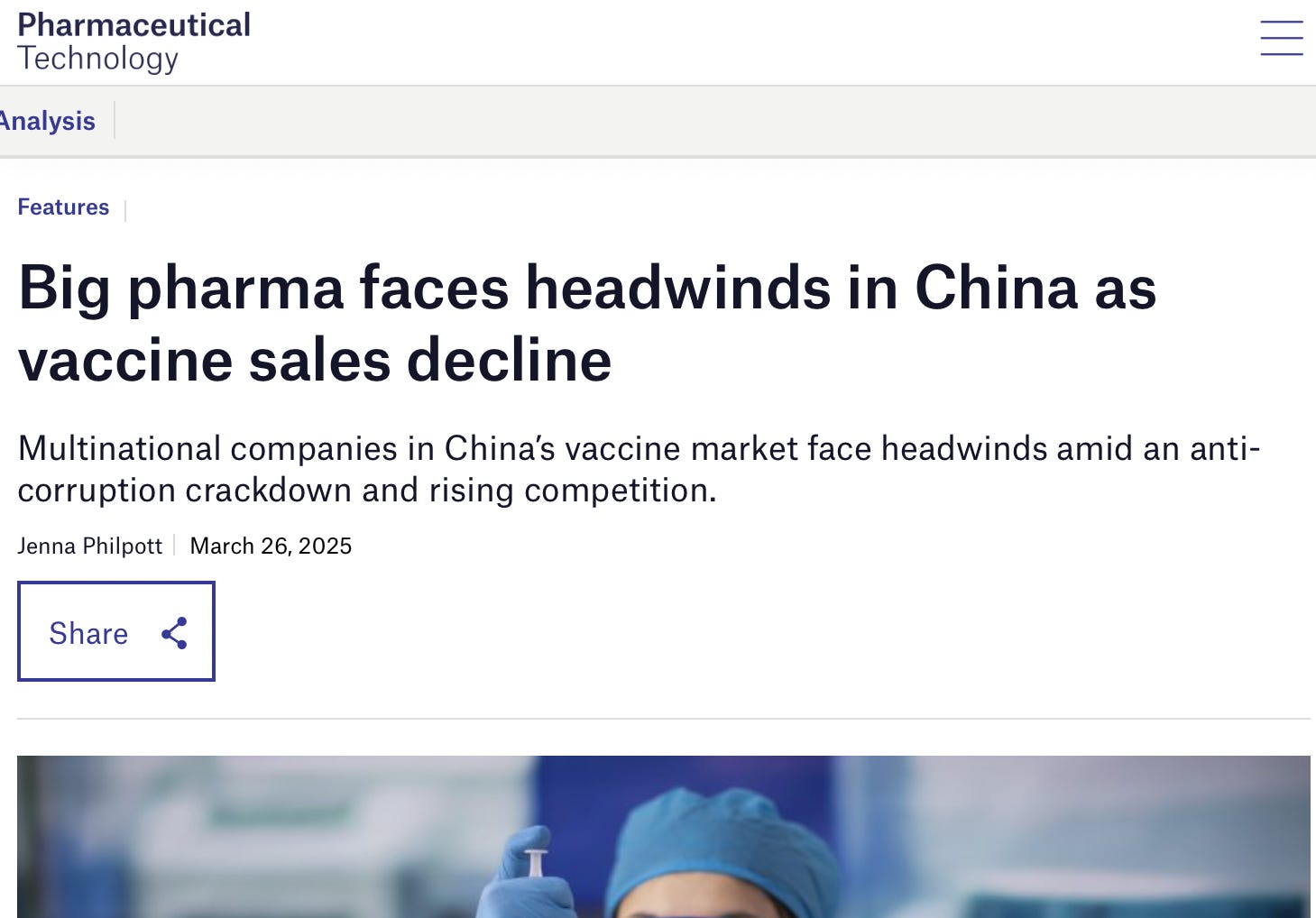
Big Pharma Faces Headwinds in China as Vaccine Sales Decline – Jenna Philpott, Pharmaceutical Technology, 26 March 2025
Foreign pharma struggles to keep pace in a shifting vaccine landscape dominated by domestic priorities.
👉 I was interviewed for this piece a few weeks ago, which looks at how multinational companies are navigating China’s complex and often unpredictable vaccine market, particularly the regulatory climate, localisation pressures, and shifting strategic landscape. As I shared in the piece:
“The foreign actors have good quality vaccines and drugs, but it's increasingly difficult to maintain good channels of influence with government, and good relationships. China's priority, like any country, is to boost its domestic capability, domestic market, and to make sure domestic pharma companies and vaccine developers win.”
I also spoke about the importance of government relations—not just for political optics, but for practical intelligence:
“[In China], these rules and regulations are often announced unexpectedly, and companies have to scramble to work out what it means... you can only get that insight through good relationships and keeping close comms.”
Revealed: Chinese researchers can access half a million UK GP records – Tom Burgis, The Guardian, 15 April 2025
New revelations about Chinese access to anonymised UK health data spark concerns over privacy and transparency.
👉 This Guardian investigation reveals that Chinese researchers have been given access to the anonymised health records of 500,000 UK citizens through the UK Biobank. The US came first in the 1,375 successful applications, and China was second (at nearly 20%). While legal, and part of international scientific collaboration, the scale and sensitivity of the data—combined with growing geopolitical tension—have raised serious questions from the British public and media about oversight, consent, and public trust in data governance. However, scientists and researchers argue for the importance of sharing and collaboration in health and science. Previously, Chinese researchers have used the data to study links between air pollution and health, and to identify biological markers that might predict. Cross-border health data sharing is evolving, and testing trust, transparency and governance in real time. In response, Prof Rory Collins, CEO of UK Biobank, penned a letter to the Guardian Editor to address safeguarding concerns and defend holistic benefits. This is definitely a topic I plan on diving deeper into.
China Biotech Startup injects CRISPR therapy into the brain for the first time – Ryan Cross, Endpoints News, 21 April 2025
In a world-first, HuidaGene delivers gene therapy directly to the brain of a child with a rare neurological disorder.
👉 This piece covers a milestone moment for China’s biotech scene: a 9-year-old with MECP2 duplication syndrome has become the first patient in the world to successfully receive CRISPR-based gene therapy injected directly into the brain. The results are still preliminary, but twelve weeks after the treatment, videos showed the boy able transform from struggling to walk without support to walking smoothly and independently. Shanghai-based startup HuidaGene is behind the trial, signalling how quickly China is moving into the frontier of high-stakes, high-complexity biotech innovation, as I recently covered in my post on China’s biotech.
China’s Obesity Crisis Is Big Business – Eleanor Olcott and Wang Xueqiao, Financial Times, 28 March 2025
Over half of Chinese adults are now overweight or obese, causing local drugmakers to target the weight loss market.
👉 This FT piece dives into the fast-growing demand for anti-obesity drugs in China. Novo Nordisk’s Wegovy has quickly gained traction, but with its patent set to expire in 2026, at least 15 Chinese companies are already racing to develop local alternatives. The article captures how pharmaceutical innovation and shifting consumer habits are colliding and reshaping China’s public health and commercial landscape. Chronic and non-communicable conditions including heart disease, cancer, diabetes and mental health were once labelled as “diseases of the West” due to associations with obesity and poor diet. But they are now huge health challenges for China too.
The Harvest: Dispatch No. 18 – Nathan Whittaker, This Week in Rural China, 18 April 2025
Rising childhood obesity rates and the launch of the "Healthy Villages" initiative in Jiangsu.
👉 I have previously talked about rural health inequalities as a persistent pressure for the health system. This great substack post at <This Week in Rural China> covers key recent developments in rural China, including increasing concern over childhood obesity in rural areas, where changing diets and reduced physical activity contribute to health challenges, an well as discusses Jiangsu government's efforts to improve rural health infrastructure and education through new initiatives and funding mechanisms. It offers valuable insights into the evolving public health landscape in China's countryside.
China Plans 'Silver Trains' to Encourage Aging Boomers to Travel - Karoline Kan, Bloomberg, 11 Feb 2025 China is launching a network of tourist trains equipped with medical and elder-care facilities to tap into the spending power of its aging population.
👉 I analysed China’s broad national plans to develop its "silver economy" in my deep dive Real Diagnosis series on the recent Two Sessions (part 1, part 2). With around 20% of the population over age 60 by the end of 2022, China wants to address demographic shifts and stimulate economic growth by catering to the needs of its elderly citizens. This piece details the "silver trains" project, highlighting China’s ambitions to integrate healthcare services into travel and leisure activities for seniors, to target what it sees as a growing market segment with significant potential.
📚 Longer Reads/Books
Two brilliantly different books on the UK-China relationship. One explores the complex history behind today’s mistrust; the other, the mismatches of cultural translation.
The Great Reversal: How We Let China Become the World’s Second Superpower – Kerry Brown
A clear-eyed account of how the UK, and the West more broadly, have misread China’s rise.
👉 Prof. Kerry Brown is one of the most thoughtful voices on UK–China relations, and this book is a concise yet accessible look at how the relationship has shifted, from cautious optimism to strategic suspicion, across over four centuries of entanglement. Understanding this backdrop is essential, especially as UK and US governments ramp up scrutiny of Chinese research partnerships. For those working in or observing global health and policy diplomacy, this context shapes how collaborations are built, how data and technology are shared, and how trust is won or lost. The book’s insights into the blind spots and missteps of the past, serve as useful lessons for us all today.
Sour Sweet – Timothy Mo
A beautifully written novel about migration, identity, and the quiet power of adaptation.
👉 Shortlisted for the Booker Prize, this novel follows a Chinese immigrant family trying to find their footing in 1960s London. This is one of those rare books I’ve re-read several times. The prose is absolutely extraordinary, and the story traces cross-cultural care, sacrifice and survival through both everyday joys and private tragedies. It’s not about health, exactly, but it captures the emotional terrain of living between systems and cultures, which feels just as vital to understand, especially for those of us working across borders.
🎧 Listens
How Trump is Affecting Health Around the World – The Lancet Voice, 6 Feb 2025The global health community is bracing for impact as the US administration pulls back foreign aid.
👉 Dr. Gavin Yamey, the lead author of The Lancet’s Commission on Investing in Health, talks about what Trump’s return means for global health. Earlier this week, I wrote about China’s health role in the global south, with relation to USAID cuts and funding freezes. This episode provides sobering context for how geopolitics impacts donor funding, multilateral systems and the health of fragile states.
I highly recommend The Lancet Voice podcast as a great general listen, because the hosts and guests always remain focused on the technical outcomes. These scientists and real experts provide an informative, yet reliably grounded perspective of the latest global health and policy issues.
The Fallout of the US Aid Freeze - Catherine Nzuki and Andrew Friedman, CSIS, 6 Feb 2025
The implications of the USAID freeze on global health initiatives, particularly in Africa.
👉 This episode of the Afropolitan podcast explores how the USAID freeze affects organisations reliant on US funding and the broader consequences for international health programmes. This conversation sheds light on the interconnectedness of global health funding and policy decisions, including the dependency debate and how disruption may be a good thing for the African continent.
I hope you’ve enjoyed this round-up—until next time!
China’s health landscape is vast, evolving, and full of stories worth exploring together, and I want to make this newsletter more than just a one-way dispatch. I’ll keep listing what I like, but I’d love to hear from you too. Drop a comment, send a note and share what’s caught your eyes and ears recently.
Keep in touch,
Ruby
📝 This is a Doctor’s Notes post from China Health Pulse, where I share a curated prescription of my top reads and listens out there right now—so you don’t have to do the digging.
Ooh, I hadn't heard of Sour Sweet. Thank you for the recommendation!